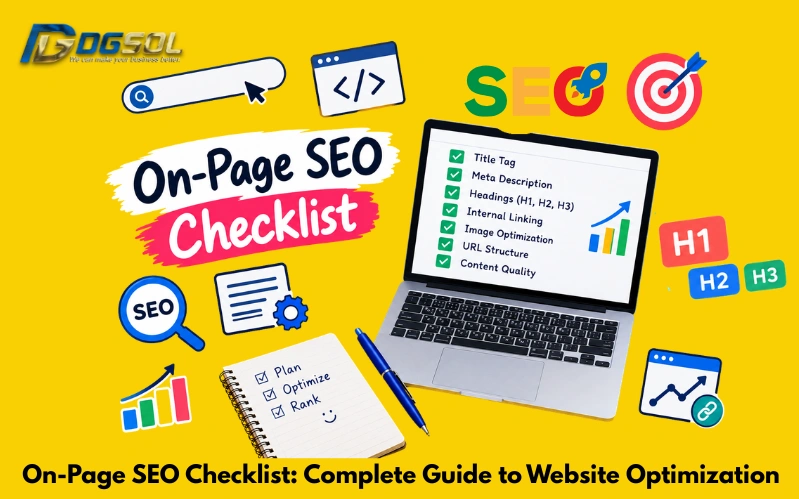
On-page SEO is the process of optimizing individual web pages so search engines can understand their content and users can find useful, relevant information. It includes elements such as title tags, meta descriptions, headings, content, URLs, internal links, images, and structured data. A strong on-page SEO strategy helps create pages that clearly match search intent while making important information easier for search engines and visitors to understand.
In 2026, on-page optimization also needs to consider AI-powered search experiences. A clear content structure, useful answers, strong topical relevance, and well-organized information can help make website content easier to understand across traditional search and newer AI-driven search experiences. This guide explains the main on-page SEO checklist, and shows how to optimize a website step by step.
What Is On-Page SEO?
On-page SEO refers to optimization activities performed directly on a website page to improve its relevance, usability, and visibility in search results. It includes both visible content and page elements that help search engines understand what a page is about.
Important areas include:
- SEO title and title tag
- H1, H2, and H3 headings
- Keyword usage and placement
- Content quality and relevance
- URL structure
- Internal linking
- Mobile usability
- Page speed and Core Web Vitals
Unlike off-page SEO, which focuses on external signals such as backlinks, on-page optimization focuses primarily on the page itself.
Why Is On-Page SEO Important?
A page can contain useful information but still perform poorly if its topic, structure, and content are unclear. For users, good page optimization makes content easier to scan, understand, and navigate. The goal is not simply to add keywords, but to create a useful, well-structured page that satisfies the reason someone searched for the topic.
Effective optimization helps search engines to understand:
- What the page is about
- Which topic or query it addresses
- How different sections relate to each other
- Whether the content satisfies the user’s search intent
- Which information is most important
- How the page connects to other pages on the website
On-Page SEO vs Technical SEO vs Off-Page SEO
A successful SEO strategy normally considers all three areas. These areas work together, but they focus on different parts of website optimization.
| SEO Type | Main Focus |
| On-page SEO | Content and page-level elements |
| Technical SEO | Crawling, indexing, performance, and website infrastructure |
| Off-page SEO | External signals such as backlinks, mentions, and authority |
For example, optimizing an article’s title, headings, content, images, and internal links is on-page SEO. Improving crawlability, XML sitemaps, server performance, and indexing is primarily technical SEO. Earning relevant backlinks and brand mentions falls under off-page SEO.
On-Page SEO Factors You Need to Optimize
There are several important elements to review when performing on-page SEO optimization.
1. Search Intent
Before optimizing a page, understand why the user is searching for the topic. Search intent generally falls into categories such as:
- Informational
- Commercial investigation
- Transactional
- Navigational
For example, someone searching “what is on-page SEO” is probably looking for an explanation. Your content should match the expected intent instead of forcing a sales message into an informational query.
2. Keyword Research
Keyword research helps identify the language people use when searching for a topic.Use relevant keywords naturally throughout the page. For an on-page SEO guide, the primary keyword might be:
on-page SEO
Related keywords can include:
- on-page SEO checklist
- on-page SEO optimization
- on-page optimization
- on-page SEO techniques
- website optimization
- how to do on-page SEO
Avoid repeating the same keyword unnecessarily. Search engines can understand related terminology and topic context, so effective keyword optimization is more about relevance and coverage than repetition.
3. Optimize the SEO Title
The SEO title, also called the title tag, is an important page-level element. A good title should clearly communicate what the page covers. For example: On-Page SEO: Complete Guide to Website Optimization
Useful title tag SEO practices include:
- Clearly describe the page topic
- Include the primary keyword naturally
- Keep the title concise enough to display effectively
- Make the title useful to searchers
- Avoid unnecessary keyword repetition
- Make each important page’s title unique
Instead of writing:
On-Page SEO | On-Page SEO Guide | On-Page SEO Optimization | SEO
use a natural title that communicates the subject clearly.
4. Useful Meta Description
A meta description summarizes the page and can influence whether a searcher chooses to visit it. Although meta descriptions are not simply a direct ranking switch, they are important for communicating the page’s value in search results.
A good SEO meta description should:
- Summarize the page
- Reflect the actual content
- Include the primary topic naturally
- Explain what readers will learn
- Encourage a relevant click
For this article:
Learn how to do on-page SEO with this complete 2026 guide covering titles, content, headings, URLs, internal links, images, schema, and more.
Avoid stuffing multiple variations of the same keyword into the description.
5. Create a Clear H1
Every important page should have a clear primary heading that tells visitors what the page is about. For this article:
H1: On-Page SEO: Complete Guide to Website Optimization
The H1 should accurately represent the main topic. Do not use an H1 simply as a place to insert every target keyword.
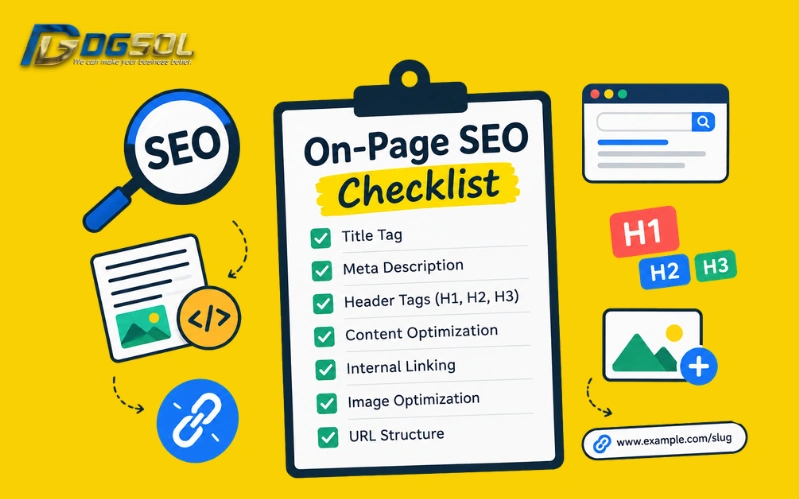
6. An Organized Heading Structure
A logical heading structure makes content easier to navigate.
Use:
- H1 for the main page topic
- H2 for major sections
- H3 for supporting subsections
For example:
H1: On-Page SEO Guide
H2: What Is On-Page SEO?
H2: On-Page SEO Factors
H3: Title Tags
H3: Meta Descriptions
H3: Internal Links
H2: On-Page SEO Checklist
A strong heading structure SEO approach helps users scan long content and makes relationships between sections clearer.
7. Match Content With Search Intent
One of the most important on-page SEO techniques is creating content that satisfies the user’s actual question. Start by asking:
What does someone expect to find after searching this keyword?
For an informational keyword such as “how to do on-page SEO”, users expect:
- An explanation
- Step-by-step instructions
- Examples
- A checklist
- Practical recommendations
Simply mentioning the keyword several times will not satisfy that intent. Your content should answer the important questions behind the query.
8. Create Helpful, Relevant Content
SEO content optimization should focus on usefulness rather than word count for guest posting or blog content alone. Longer content is not automatically better. Strong SEO-friendly content should:
- Answer the main question
- Cover important subtopics
- Provide practical information
- Use clear language
- Avoid unnecessary repetition
- Demonstrate relevant expertise
- Keep information accurate and current
- Provide examples where useful
A 2,000-word article that repeats the same ideas may provide less value than a concise article that completely answers the searcher’s needs.
9. Use Keywords Naturally
Keyword placement still matters because it helps communicate the subject of a page. Depending on the content, naturally consider the primary topic in areas such as:
- SEO title
- H1 heading
- Introduction
- Relevant H2/H3 headings
- Main body content
- URL
- Image alt text when genuinely descriptive
- Internal anchor text where appropriate
- Meta description
However, do not force keywords into every heading or paragraph. Use related terminology and natural language to build topical relevance.
10. Optimize the URL Structure
An SEO-friendly URL should be short, descriptive, and easy to understand. For this article, a suitable URL could be:
/on-page-seo/
or:
/on-page-seo-guide/
Good URL optimization practices include:
- Keep URLs concise
- Describe the page topic
- Use readable words
- Use hyphens between words
- Avoid unnecessary parameters when possible
- Avoid keyword stuffing
- Keep important URLs stable
A URL such as:
/page?id=12345
provides much less context than:
/on-page-seo-guide/
11. Build Internal Linking Strategy
Internal linking connects pages within the same website. A well-planned internal linking strategy can help users discover related content and help search engines understand relationships between pages.
For example, an article about on-page SEO could naturally link to related pages covering:
- SEO content writing
- Technical SEO
- Local SEO
- SEO audits
- Link building
- Digital marketing
Use descriptive anchor text where appropriate.
For example:
SEO content writing
is generally more informative than:
click here
Internal links should be useful to the reader rather than added simply to increase the number of links on a page.
12. Optimize Images for SEO
Images can improve content when they add useful context, examples, or visual explanations. Image SEO includes several areas:
- Use Descriptive File Names
Instead of:
IMG12345.jpg
use something descriptive such as:
on-page-seo-checklist.jpg
- Add Relevant Alt Text
Alt text should describe the image when the image provides meaningful information.
For example:
“On-page SEO checklist showing key website optimization elements” Do not use alt text as a place to insert unrelated keywords.
- Compress Images
Large image files can negatively affect page performance. Use appropriately sized images and modern formats where supported.
- Use Relevant Images
Do not add images simply because every article needs a certain number of images.The image should support the content.
13. Structured Data Where Appropriate
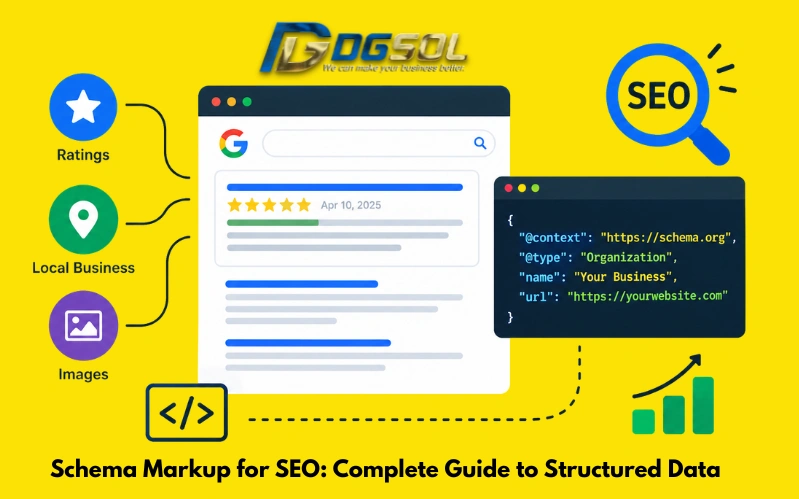
Schema markup is structured information that can help search engines understand certain types of content.
Common types include:
- Article
- Breadcrumb
- Organization
- Local Business
- Product
- Event
- FAQ where appropriate
Structured data should accurately represent visible or relevant page information. Do not add schema simply to manipulate search results.
14. Improve Page Speed
Website performance is an important part of the overall user experience. Review:
- Largest page elements
- Image sizes
- JavaScript
- CSS
- Server response
- Browser caching
- Third-party scripts
- Mobile performance
Core Web Vitals provide useful measurements related to loading performance, responsiveness, and visual stability. Improving website speed can make pages easier to use, especially on mobile connections.
15. Make Your Website Mobile-Friendly
Many users access websites through smartphones. A mobile-friendly website should provide:
- Responsive layouts
- Readable text
- Easy navigation
- Properly sized buttons
- Fast loading
- Accessible menus
- Content that works across different screen sizes
Check important pages on actual mobile devices as well as browser testing tools.
16. Use Canonical Tags Correctly
Canonical tags can help communicate which URL should be treated as the preferred version when similar or duplicate URLs exist. They are particularly useful for websites that generate multiple URL variations. However, canonicalization should be handled carefully.
Make sure the canonical URL:
- Is the preferred version
- Is accessible
- Matches the intended page
- Does not point unnecessarily to an unrelated page
17. Optimize Content for AI Search
Search behavior is changing, and users increasingly encounter answers generated or summarized by AI systems. It makes AI search optimization an important consideration in modern content strategy. Instead of creating content specifically to manipulate AI systems, focus on making information clear and useful.
Helpful practices include:
- Answer important questions directly
- Use descriptive headings
- Organize information logically
- Define technical terms
- Provide original insights
- Support factual claims where appropriate
- Use clear lists when they improve understanding
- Maintain consistent information about your business
- Make important entities and relationships clear
On-Page SEO Process: Step-by-Step
A repeatable workflow makes website optimization easier.Update the page when information becomes outdated or when search intent changes.
Step 1: Identify Search Intent
Understand what users expect from the target query.
Step 2: Perform Keyword Research
Identify the primary keyword, related terms, questions, and relevant subtopics.
Step 3: Select the Primary Keyword
Choose one primary topic for the page rather than trying to target unrelated keywords.
Step 4: Optimize the URL
Create a concise and descriptive URL.
Step 5: Write the SEO Title
Create a clear title that accurately represents the page.
Step 6: Write the Meta Description
Summarize the page and explain its value to searchers.
Step 7: Create the H1
Use a clear primary heading that matches the page topic.
Step 8: Build H2 and H3 Sections
Organize the article around the questions and subtopics users care about.
Step 9: Optimize the Content
Improve relevance, clarity, depth, examples, and search-intent alignment.
Step 10: Add Internal Links
Connect the page with relevant content across your website.
Step 11: Optimize Images
Use useful images, descriptive file names, appropriate alt text, and compressed files.
Step 12: Add Relevant Schema
Implement structured data where it accurately applies.
Step 13: Check Mobile Experience
Make sure the page is easy to use on smartphones.
Step 14: Review Performance
Check page speed and Core Web Vitals.
Step 15: Review Indexing Signals
Check canonical tags, indexability, and other technical signals that affect whether the page can be discovered and indexed.
Step 16: Monitor and Update
Review organic traffic, rankings, engagement, conversions, and content performance.
Common On-Page SEO Mistakes
Here are some common onpage seo optimization mistakes which are given as:
1. Keyword Stuffing
Repeating a keyword excessively can make content unnatural. Use keywords where they help describe the topic and use natural variations throughout the article.
2. Writing Only for Search Engines
Content should be created for people first. If a page reads awkwardly because keywords have been inserted everywhere, the optimization has gone too far.
3. Ignoring Search Intent
A page can target the correct keyword but still fail to satisfy users if the content format does not match their expectations.
4. Using Generic Titles
Titles such as:
Website SEO
provide little information.
A more descriptive title communicates exactly what users will learn.
5. Weak Internal Linking
Publishing useful articles without connecting them can make it harder for users to discover related information.
6. Neglecting Images
Large, poorly optimized images can affect page performance and user experience.
7. Ignoring Mobile Users
A page that works well on desktop but is difficult to navigate on mobile needs improvement.
8. Focusing Only on Word Count
There is no universal word count that guarantees rankings. Focus on satisfying the topic and search intent instead.
9. Ignoring Existing Content
SEO is not only about creating new pages. Updating and improving existing content can also be an important part of a long-term optimization strategy.
On-Page SEO for AI Search in 2026
The growth of AI-powered search makes information structure increasingly important.
Businesses should focus on creating content that is:
- Clear and easy for users and search systems to understand
- Specific enough to answer the actual search intent
- Well organized with logical headings, sections, lists, and supporting information
- Factually responsible and based on reliable information
- Topically relevant to the main subject of the page
- Easy to understand without unnecessary jargon or complicated wording
- Supported by useful evidence, examples, data, references, or first-hand information where appropriate
- Consistent across important business pages, including services, products, company information, and contact details
- Updated when information changes, especially for pricing, services, regulations, statistics, and industry developments
- Written for people first, rather than created primarily to insert keywords
This is where traditional SEO, AI SEO, semantic SEO, and entity SEO increasingly overlap.
Final Thoughts
On-page SEO remains a fundamental part of website optimization. From SEO title tags and meta descriptions to headings, search intent, content, URLs, internal links, images, schema, mobile usability, and page performance, every element contributes to how effectively a page communicates its topic and serves its visitors.
The best approach is not to optimize pages around keywords alone. Instead, build a structured SEO strategy that starts with search intent, creates useful content, improves page-level elements, connects related pages, and continuously monitors performance.
In 2026, this approach also provides a strong foundation for AI search optimization. Clear information architecture, useful answers, strong topical relevance, and well-structured content can make your website easier to understand across evolving search experiences. A consistent optimization can help create a more useful, accessible, and search-friendly website over time.
Frequently Asked Questions
Why is on-page SEO important?
On-page SEO helps search engines understand a page’s topic and helps users find and navigate useful information. It is an important part of a broader SEO strategy.
How do I do on-page SEO step by step?
Start by identifying search intent and researching keywords. Then optimize the URL, title, meta description, H1, headings, content, internal links, images, structured data, mobile experience, and page performance. Finally, monitor and update the page.
What are the main on-page SEO factors?
Important factors include search intent, content relevance, title tags, meta descriptions, headings, URLs, internal links, images, structured data, mobile usability, page performance, and canonical signals.
Does word count matter for on-page SEO?
There is no universal word count that guarantees better rankings. Content should be long enough to satisfy the topic and search intent without adding unnecessary information.
What is schema markup in SEO?
Schema markup is structured data that provides search engines with additional information about certain types of content or entities on a page. It should accurately represent the information it describes.
How does on-page SEO support AI search?
Well-structured, relevant, and clearly written content is easier for search systems to interpret. Answering important questions directly and organizing information with descriptive headings can support visibility across evolving AI-powered search experiences.
How often should I update on-page SEO?
Review important pages periodically and update them when information, search intent, products, services, or industry conditions change. Performance data can also indicate when a page needs improvement.