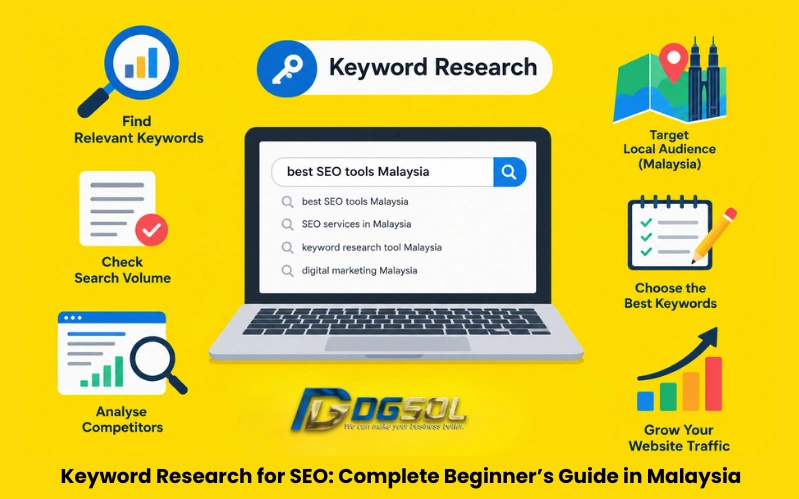
Keyword research is one of the first steps in a successful SEO strategy. It helps you understand what people search for on Google, why they search for it, and which search terms are relevant to your business. For businesses, keyword research Malaysia requires more than simply finding keywords with high search volume. You also need to consider search intent, keyword difficulty, local locations, long-tail searches, language preferences, competitors, and the value a keyword can bring to your website. This complete guide explains how to do keyword research for SEO step by step, how to choose the right keywords, which tools to use, and how to build a practical keyword strategy for the Malaysian market.
What Is Keyword Research?
Keyword research is the process of finding and analyzing the words and phrases people use when searching for information, products, services, or solutions on search engines. For example, someone looking for technical SEO services might search for:
- SEO services Malaysia
- Technical SEO agency
- Best SEO company
- SEO agency Kuala Lumpur
- SEO company KL
- affordable SEO services
These searches represent different keyword opportunities. Some have broad intent, while others show a much clearer location or commercial need. It helps you discover these opportunities before creating or optimizing content.
What Does Keyword Research Involve?
The objective is not to collect as many keywords as possible but is to identify the keywords that are relevant to your audience and useful for your SEO strategy. A complete SEO keyword research process can include:
- Finding seed keywords
- Expanding keyword ideas
- Understanding search intent
- Checking search volume
- Evaluating keyword difficulty
- Reviewing keyword competition
- Finding long-tail keywords
- Identifying local keywords
- Researching competitor keywords
- Finding keyword gaps
- Grouping related keywords
- Mapping keywords to website pages
How to Do Keyword Research for SEO
A practical keyword research process has several steps, which are as follows.
Step 1: Define Your Business and SEO Goals
Before using a keyword research tool, understand what you want your SEO campaign to achieve.
Start by identifying:
- Your products or services
- Your main business goals
- The problems your customers want to solve
- The pages you want to promote
- Whether you need traffic, leads, sales, or brand visibility
For example, a digital marketing agency might target:
Audience: Local SMEs
Location: Malaysia
Services: SEO, social media marketing, website development
Goal: Generate qualified leads
This information gives your keyword research a clear direction.
Step 2: Create Seed Keywords
Seed keywords are the basic terms you use to start your research. The seed list does not need to be perfect. It is simply the starting point for finding more specific keyword opportunities.
For an SEO agency, seed keywords could include:
- SEO services
- SEO agency
- SEO company
- local SEO
For an online retailer, seed keywords could instead include:
- men’s shoes
- running shoes
- women’s shoes

Step 3: Expand Your Keyword List
Once you have seed keywords, expand them into related searches. For example: Seed keyword: On-page SEO services, such as,
Possible variations include:
- On-page SEO services
- SEO company Malaysia
- affordable SEO services
- local SEO services
- On-page SEO services Kuala Lumpur
You can also expand keywords using:
- Questions
- Comparisons
- Problems
- Locations
- Services
- Products
- Features
- Customer needs
Step 4: Understand Search Intent
Search intent is the reason behind a user’s search. Understanding intent is essential because the same topic can have very different types of searches.
1. Informational Search Intent
The user wants to learn something.
Examples:
- What is keyword research?
- How does SEO work?
- How to find keywords for SEO
- What is keyword difficulty?
These searches usually require educational content.
2. Navigational Search Intent
The user wants to find a particular website, company, or destination.
Examples:
- Google Keyword Planner
- Google Search Console
- Ahrefs
- Semrush
3. Commercial Search Intent
These searches may require comparison pages, service pages, or detailed guides. The user is researching before making a decision.
Examples:
- best keyword research tools
- SEO agency
- SEO packages Malaysia
- keyword research software
4. Transactional Search Intent
The user is ready to take an action.
Examples:
- hire SEO agency Malaysia
- buy SEO software
- keyword research service
These keywords can have strong commercial value.
How to Identify Search Intent
You can identify keyword search intent by examining the current search results. For example, if most results for a keyword are beginner guides, creating a product page for that keyword may not match the search intent. Your goal is to create the type of content that best satisfies what the searcher is looking for.
Step 5: Analyze Keyword Search Volume
Keyword search volume estimates how frequently a keyword is searched during a particular period. It helps you to understand the potential demand for a topic. However, search volume should not be the only factor you use when selecting keywords.
A high-volume keyword may have:
- Strong competition
- Broad intent
- Low business relevance
- High ranking difficulty
A lower-volume keyword may have:
- Clearer intent
- Strong commercial relevance
- Less competition
- A more specific audience
Therefore, keyword selection should consider several factors, not monthly search volume alone.
Step 6: Evaluate Keyword Difficulty
Keyword difficulty is a metric SEO tools use to estimate how hard it may be to compete for a keyword. Different tools use different calculations, so treat difficulty scores as comparison indicators rather than guarantees.
When evaluating difficulty, consider:
- Strength of ranking websites
- Number and quality of backlinks
- Content quality
- Search intent
- Topical relevance
- Domain strength
- Your own website’s authority
Step 7: Analyze Keyword Competition
Keyword competition and keyword difficulty are related, but you should also manually examine the search results.
Ask:
- Which websites rank?
- Are they highly authoritative brands?
- Are the results mostly local businesses?
- Are there specialist websites?
- Does the current content fully answer the query?
- Are there weak or outdated results?
- Does your business have something useful to add?
This manual review can reveal opportunities that a keyword difficulty score alone may not show.
Step 8: Evaluate Traffic Potential
Search volume doesn’t always reflect the total traffic a page can receive. A single page can potentially rank for many related searches. For example, a page targeting “keyword research”
could also naturally appear for related searches such as:
- keyword research for SEO
- SEO keyword research
- how to do keyword research
- keyword research guide
- keyword research process
- keyword research strategy
This is why you should consider traffic potential alongside individual keyword volume.
Step 9: Find Long-Tail Keywords
Long-tail keywords are more specific search queries that usually contain several words.
For example:
Broad keyword:
- SMM
More specific keyword:
- SMM services
Long-tail keyword:
- affordable SMM services for small businesses in Malaysia
Long-tail searches can be useful because they often communicate a clearer need.
Step 10: Find Low-Competition Keywords
Beginners often target low-competition keywords because broad keywords can be hard to compete for. When looking for opportunities, combine:
- Keyword relevance
- Search intent
- Search volume
- Keyword difficulty
- Competition
- Traffic potential
- Business value
For example, an SME may have a better opportunity with a specific service-and-location keyword than with an extremely broad keyword.
Best Keyword Research Tools
There are many keyword research tools available. You do not necessarily need every tool. Choose tools that provide the data needed for your research process.
1. Google Keyword Planner
Google Keyword Planner is a useful starting point for keyword discovery and search demand research.
You can use it to:
- Discover keyword ideas
- Explore related terms
- Review search volume ranges
- Examine competition data
- Research location-specific terms
- Build keyword lists
For businesses, you can set the research location to Malaysia or specific local locations, when appropriate.
2. Google Search Console Keyword Research
Google Search Console is especially useful for websites that already receive organic impressions.
Search Console can show:
- Search queries
- Impressions
- Clicks
- Click-through rate
- Average position
- Pages receiving search traffic
Look for keywords where your pages receive impressions but have relatively few clicks. This makes Search Console valuable for ongoing keyword research, not just initial research.
3. Google Trends Keyword Research
On digital platforms, Trends can help you understand how Google search interest changes over time.
Use it to investigate:
- Seasonal searches
- Rising topics
- Declining topics
- Regional differences
- Related searches
- Keyword comparison
4. Google Autocomplete
Autocomplete should be treated as a source of ideas rather than proof that every suggested term has significant search volume. The tool suggests terms as you type.
For example:
keyword research…
may produce variations around:
- keyword research tools
- keyword research for SEO
- keyword research Malaysia
- keyword research guide
5. People Also Ask
Google’s People Also Ask results can reveal questions related to a topic. For keyword research, these questions can help you identify:
- Supporting topics
- FAQ opportunities
- Long-tail keywords
- User questions
- Search intent
For example, researching keyword difficulty may reveal related questions about search volume, competition, and ranking.
Keyword Mapping for SEO
After researching keywords, organize them into a keyword map. What Is Keyword Mapping? Keyword mapping is the process of assigning relevant keywords to specific website pages.
For example:
| Website Page | Primary Keyword | Supporting Keywords |
| Homepage | digital marketing agency Malaysia | digital marketing company Malaysia |
| SEO Service Page | SEO services Malaysia | SEO agency Malaysia |
| Blog | keyword research | SEO keyword research |
| Local SEO Page | local SEO Malaysia | local SEO services |
Keyword Clustering for SEO
Keyword clustering means grouping closely related keywords that share a similar topic or search intent.
For example:
Main Topic
Keyword Research
Related Keywords
- keyword research for SEO
- SEO keyword research
- keyword research guide
- keyword research process
- keyword research strategy
These terms can potentially be addressed within the same comprehensive resource when they share the same search intent. Keyword clustering can also help you identify when separate pages are more appropriate.
How to Choose the Right SEO Keywords
Choosing keywords should involve more than looking at search volume. Evaluate each keyword using the following factors.A useful framework is:
Relevance + Intent + Search Demand + Difficulty + Competition + Traffic Potential + Business Value
- Relevance
Does the keyword directly relate to your business, service, product, or topic?
- Search Intent
Does the keyword’s intent match the page you want to create?
- Search Volume
Does the keyword have meaningful search demand?
- Keyword Difficulty
How competitive is the search result?
- Business Value
Could the searcher realistically become a customer?
- Traffic Potential
Could one page attract visitors from multiple related searches?
- Competition
Which websites currently rank?
- Location
Does the keyword match your target Malaysian market?
How Many Keywords Should a Page Target?
There is no universal number of keywords that every page should target. Instead, focus on:
- One clear primary topic
- Closely related secondary keywords
- Supporting questions
- Relevant long-tail searches
- Related concepts and entities
- Search intent
For example, a page about keyword research can naturally discuss keyword difficulty, search intent, long-tail keywords, keyword tools, and keyword mapping because these topics are closely related.
Common Keyword Research Mistakes to Avoid
Beginners often make the following mistakes:
- Choosing keywords only because they have high search volume
- Ignoring search intent
- Targeting keywords unrelated to the business
- Ignoring local search behavior
- Translating keywords without checking actual search behavior
- Targeting highly competitive keywords without considering alternatives
- Ignoring long-tail keywords
- Copying competitor keywords without evaluating them
- Creating multiple pages for the same search intent
- Ignoring keyword cannibalization
- Stuffing keywords into content
- Ignoring existing Search Console data
- Focusing only on informational keywords
- Ignoring commercial searches
- Not checking search trends
- Failing to update keyword research
- Mapping multiple pages to the same primary keyword unnecessarily
How to Build a Keyword Research Strategy
A sustainable keyword research strategy should not end after you publish one article. Use this process:
Research → Analyze → Categorize → Prioritize → Map → Create → Optimize → Monitor → Update
- Research
Find relevant keywords and search queries.
- Analyze
Evaluate intent, volume, difficulty, competition, and business value.
- Categorize
Group keywords according to topics, intent, location, and audience.
- Prioritize
Choose the opportunities that best fit your website and business goals.
- Map
Assign keywords to the most appropriate website pages.
- Create
Develop useful content that satisfies the search intent.
- Optimize
Improve titles, headings, content, internal links, and other relevant page elements.
- Monitor
Review organic impressions, clicks, rankings, and conversions.
- Update
Refresh your keyword strategy as search behavior, competition, and business priorities change.
Final Thoughts
Effective keyword research for SEO means understanding how your audience searches and choosing topics that connect those searches to your website. The process starts with seed keywords but should go much further. Before deciding which terms to target, examine search intent, search volume, keyword difficulty, competition, traffic potential, long-tail keywords, local searches, and business value. For businesses targeting Malaysia, the process should also consider keyword research, local locations, multilingual search behavior, top competitors, and local search intent.
A practical keyword research process can be summarized as:
Find the keywords → Understand the intent → Analyze the opportunity → Group related terms → Map them to pages → Create useful content → Monitor and update.
The goal is not to rank for every possible keyword. The goal is to build a focused keyword strategy that connects relevant searches with useful pages and meaningful business opportunities.