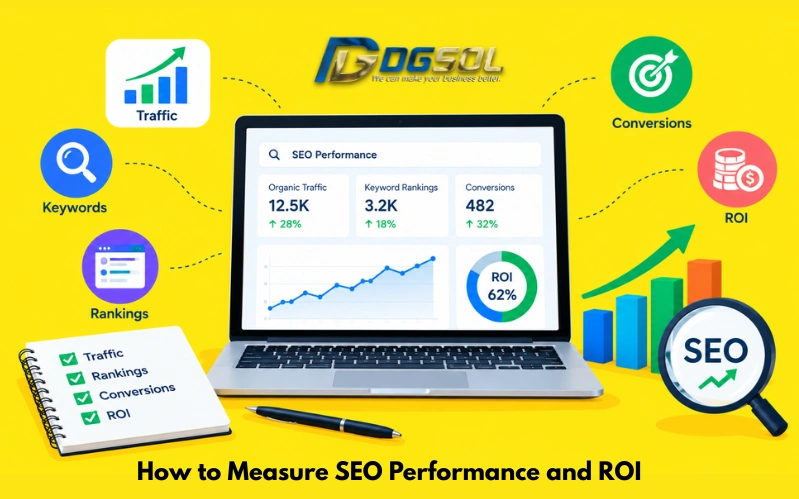
Measuring SEO performance is essential for understanding whether your search engine optimization efforts are delivering meaningful results. Tracking keyword rankings and website traffic can show changes in search visibility, but these metrics alone do not tell you whether SEO is generating qualified leads, sales, or revenue.
A reliable search engine measurement process combines search performance data, website analytics, conversion tracking, and financial information. This helps businesses understand what is improving, which pages need attention, and whether their investment is contributing to business goals.
Whether you manage SEO for a small business, ecommerce website, or B2B company, the right metrics make it easier to evaluate performance and plan future improvements. In this guide, you will learn how to measure SEO performance, choose the right KPIs, track organic traffic and conversions, calculate ROI, and create reports that turn data into actionable decisions.
What Does SEO Performance Mean?
SEO performance refers to how effectively a website achieves its organic search objectives. These objectives may include improving visibility in search results, attracting relevant visitors, generating leads, increasing ecommerce sales, or supporting long-term business growth.
SEO Performance vs. SEO Results vs. SEO ROI
Understanding these differences helps you choose the right measurements for your business.
| Measurement | What it tells you | Example |
| SEO performance | How search visibility and organic traffic are changing | Organic clicks increase over three months |
| SEO results | What measurable outcomes SEO contributes to | Organic search generates more qualified inquiries |
| SEO ROI | How the value generated compares with the SEO investment | Attributed organic revenue exceeds the recorded SEO costs |
For example, a page may improve its average search position and attract more clicks without generating additional customers. In that situation, search performance has improved, but the business impact still needs to be evaluated.
How to Measure SEO Performance Step by Step
A practical measurement process starts with clear business goals and ends with specific actions based on the data.
Step 1: Define Your SEO Goals
Before choosing metrics, identify what SEO needs to achieve. For example, a B2B business may want to increase the number of qualified organic leads, while an ecommerce store SEO may focus on increasing purchases and revenue from organic search.
Your goals could include improving visibility for important service pages, attracting relevant non-branded traffic, increasing organic conversions, or improving revenue from organic landing pages. Make each goal specific enough to evaluate. “Improve SEO” is too broad because it does not define what success means.
Step 2: Establish an SEO Performance Baseline
Record the website’s current performance before evaluating the impact of new SEO work.
Depending on your objectives, document:
- Google Search clicks and impressions.
- Organic website sessions and users.
- Performance of important landing pages.
- Rankings for selected keyword groups.
- Organic leads, purchases, and revenue.
- SEO expenses, including staff time, tools, and services.
A baseline allows you to compare future performance with an established starting point.
Use comparable reporting periods where possible. For example, compare the latest 90 days with the previous 90 days and investigate seasonal differences before drawing conclusions.
Step 3: Select the Right SEO KPIs
Key performance indicators, or KPIs, are the measurements you use to evaluate progress toward a specific goal. Choose a manageable set of KPIs rather than tracking every available metric.
For a lead-generation business, qualified leads and organic conversion rate may be more important than total page views. For an ecommerce store, organic revenue, purchases, and conversion rate may be more useful.
Each KPI should have a clear purpose and a reliable data source.
Step 4: Configure SEO Analytics and Conversion Tracking
Use Google Search Console to understand search visibility and Google Analytics 4 (GA4) to analyze visitor activity on your website.
Configure appropriate events to measure valuable actions, such as submitted inquiry forms, completed purchases, bookings, or other conversions relevant to the business.
If you operate a B2B business, connecting analytics with CRM or sales data can help you assess whether organic inquiries become qualified opportunities or paying customers.
Check that the tracking is working correctly before relying on the numbers to evaluate SEO performance or calculate ROI.
Step 5: Compare Results Over Consistent Periods
Review performance over time rather than relying on a single day’s or week’s data.
Compare equivalent periods and consider factors such as seasonal demand, promotions, website migrations, technical changes, and major shifts in search visibility.
A traffic decline does not automatically mean SEO work has failed. It may be caused by reduced demand, a change in search results, or a tracking issue. Investigate the data before making significant changes.
Step 6: Turn the Data Into an Action Plan
Once you understand the results, identify the next steps.
For example, pages receiving impressions but few clicks may need a closer review of their search intent, titles, or rankings. Pages attracting relevant traffic but few conversions may need better content, clearer calls to action, or a more useful user experience.Prioritize actions according to their likely business impact, effort, and urgency.
SEO Performance Metrics: What Should You Measure?
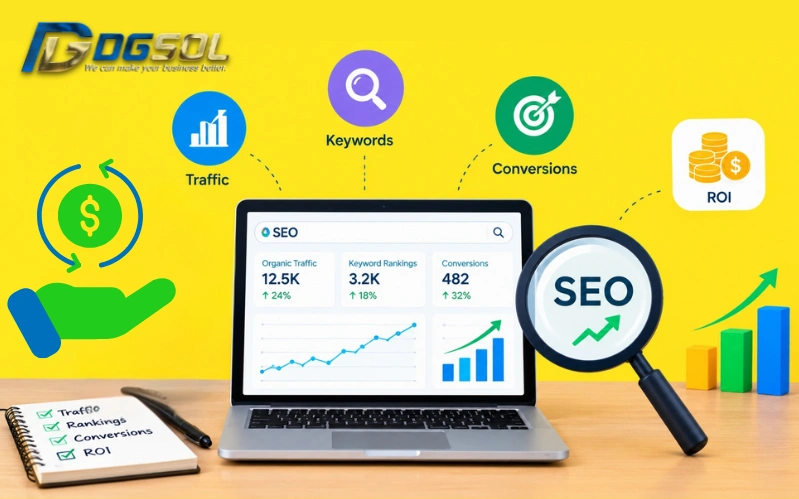
The most useful SEO performance metrics fall into several categories. These categories help you understand search visibility, website activity, technical health, and business outcomes.
Search Visibility Metrics
Search visibility metrics show how a website performs in organic search results.
1. Impressions:
The number of times your site appears in Google Search results under Google’s measurement rules. Rising impressions can indicate that more searches are showing your pages.
2. Organic clicks:
The number of clicks your pages receive from Google Search results. This indicates how often users visit your website directly from those results.
3. Click-through rate (CTR):
The percentage of impressions that result in clicks. CTR is calculated by dividing clicks by impressions and multiplying by 100.
4. Average position:
An aggregate measure of where your site’s topmost result appears in relevant search results. It is useful for observing trends, but it should not be treated as the exact ranking every user sees.
These measurements are available in Google Search Console’s Performance report.
Organic Traffic Metrics
Organic traffic metrics help you understand how much website activity comes from organic search and which pages attract visitors.
Important measurements include:
- Organic sessions: Visits attributed to organic search under the analytics platform’s source classification.
- Organic users: Users associated with organic search activity, depending on the selected report and attribution scope.
- Landing page traffic: Visits that begin on specific pages, including product pages, service pages, and blog articles.
- Traffic by device: Differences between mobile and desktop performance.
- Traffic by location: Organic activity from countries or regions relevant to your business.
Use these metrics to identify pages that attract relevant visitors and topics that contribute to organic traffic growth.
However, more traffic is not always better. A page receiving visitors from irrelevant searches may contribute little business value, even if its overall traffic is increasing.
Engagement and Traffic Quality Metrics
Engagement metrics help you understand how visitors interact with your website. Depending on your setup, these may include engaged sessions, interactions with important content, or meaningful events completed by visitors.
Use these figures alongside the page’s purpose. A detailed informational article may answer a question quickly, while a service page may need visitors to complete an enquiry form.
A short visit is not automatically unsuccessful, and high engagement does not automatically mean a page generates revenue. Interpret engagement in the context of user intent and business goals.
Conversion and Business Metrics
Conversion and business metrics help you evaluate whether organic traffic contributes to meaningful outcomes.
Important measurements include:
- Organic leads and purchases.
- Organic conversion rate.
- Qualified leads and sales opportunities.
- Revenue attributed to organic search.
- Average order value for ecommerce businesses.
- Cost per lead and customer acquisition cost.
- Profit contribution where reliable financial data is available.
These metrics are particularly important when reporting SEO performance to business owners, clients, or management.
Technical SEO Health Metrics
Technical SEO metrics help identify issues that may prevent important pages from being discovered, crawled, indexed, or used effectively. Review relevant indicators such as indexing problems, broken internal links, incorrect canonical tags, server errors, and page performance.
Core Web Vitals can help you evaluate aspects of real-world loading performance, responsiveness, and visual stability. Treat technical metrics as diagnostic indicators rather than direct substitutes for business KPIs. Fixing an issue can improve a website’s technical condition, but the business impact should still be evaluated.
SEO KPIs: How to Choose the Right Metrics for Your Business
A metric becomes a KPI when it is selected to evaluate progress toward an important objective. The most useful SEO KPIs depend on your business model and the results you want to achieve.
| Business goal | KPI to track | Data source |
| Improve search visibility | Impressions and clicks | Google Search Console |
| Attract relevant visitors | Organic sessions and landing pages | GA4 |
| Generate qualified leads | Organic inquiries and qualified leads | GA4 and CRM or lead records |
| Increase online sales | Organic purchases and revenue | GA4 and ecommerce records |
| Evaluate financial returns | SEO ROI | Financial records and conversion data |
SEO Conversion Tracking: Measure Leads, Sales, and Revenue
SEO conversion tracking connects organic website activity with meaningful customer actions. It is essential for understanding whether search visitors contribute to business objectives.
1. Decide What Counts as an SEO Conversion
The right conversion depends on your business. For a service website, it may be a successfully submitted inquiry form or a qualified phone call. For an ecommerce website, it is often a completed purchase. Other businesses may measure bookings, registrations, downloads, or other actions that represent real progress toward a goal.
Avoid treating every button click, page view, or interaction as a completed conversion unless it genuinely represents the outcome you want to measure.
2. Set Up and Verify Conversion Tracking
A reliable conversion tracking process involves:
- Defining the actions that matter to the business.
- Configuring the appropriate analytics events or tracking tags.
- Confirming that events fire under the correct conditions.
- Reviewing organic traffic sources and conversion reports.
- Checking for missing or duplicated events.
Implementation will differ according to your website platform, forms, ecommerce system, and analytics setup.
3. Track Organic Leads Through the Sales Funnel
A submitted form does not necessarily represent a qualified prospect or a paying customer. Where possible, connect your website data with CRM or sales records to understand which organic leads become qualified opportunities and which eventually become customers.
This is particularly valuable for B2B businesses, where the time between a search visit and a completed sale may be lengthy.
Measure Organic Revenue
For ecommerce websites, review revenue from purchases associated with organic traffic under your analytics configuration. For service businesses, you may use recorded sales or a clearly explained lead-value model when direct transaction-level tracking is unavailable.
Be consistent about which conversions are included, how values are calculated, and which attribution model is used. Revenue attributed to organic search is not automatically the same as incremental revenue caused by SEO.
Which SEO Costs Should You Include?
Count only the applicable portion of shared resources and avoid counting the same expense twice. SEO investment costs may include:
- Agency and consultant fees: Payments for SEO strategy, audits, implementation, reporting, and ongoing Google profile optimization.
- Internal staff time: The relevant cost of employees working on SEO, content, development, analytics, or related tasks.
- Content production: Research, writing, editing, design, and the creation of other useful content assets.
- Technical SEO and development: Website fixes, template changes, site migrations, or developer time allocated to SEO.
- SEO tools: Subscriptions used for keyword research, rank tracking, crawling, backlink analysis, and performance reporting.
- Promotion and digital PR: Relevant expenditure supporting content distribution or link earning.
SEO Performance Reporting: Turn Data Into Decisions
An SEO performance report should explain what changed, why it may have changed, and what action should follow.
What to Include in an SEO Performance Report
A useful report should include:
- Business objectives and the reporting period.
- The baseline and comparison period.
- Organic clicks, impressions, and relevant search trends.
- Organic traffic and important landing pages.
- Leads, purchases, conversion rates, and revenue where available.
- SEO investment costs when evaluating ROI.
- Key findings, limitations, and the next actions.
Avoid filling reports with metrics that are not connected to a decision or business objective.
SEO Performance Benchmarks: How Do You Know Whether Results Are Good?
SEO performance should be evaluated in the right context rather than against a single set of benchmark figures.
1. Compare Results With Your Own Baseline
Review changes in search visibility, relevant traffic, conversions, and financial outcomes against a comparable historical period. Use consistent definitions for your KPIs so that changes reflect performance rather than changes in measurement.
2. Account for Seasonality and Search Demand
Search interest can change with seasons, promotions, holidays, industry trends, and product availability. When performance changes, consider whether demand has changed alongside rankings or website quality. This helps avoid treating every decline as a technical SEO failure.
3. Compare Performance by Page and Search Intent
Site-wide averages can hide important differences. For example, a blog section may attract more informational traffic while a service page loses qualified inquiries. Separate the performance of informational, commercial, and transactional landing pages to understand which parts of the site need attention.
4. Set Realistic SEO Targets
Use historical results, search demand, competition, conversion data, and business priorities to create realistic targets. Avoid guaranteeing exact rankings, traffic increases, or ROI percentages without a defensible basis. SEO outcomes depend on factors that cannot be fully controlled.
Best Tools for SEO Results Tracking
The right SEO analytics tools depend on what you need to measure. A focused set of tools is often more useful than using several overlapping platforms without a clear purpose.
1. Google Search Console
Use Search Console to analyze Google Search clicks, impressions, CTR, average position, query performance, and relevant indexing information. It is particularly useful for understanding which searches and pages contribute to search visibility.
2. Google Analytics 4
GA4 helps you assess organic sessions, landing page activity, engagement, key events, and revenue when the relevant tracking is configured correctly. Use the Traffic acquisition report to evaluate traffic sources and the Pages and screens reports to analyze content activity.
3. Keyword Rank Tracking and SEO Research Tools
Rank tracking tools can help you monitor selected keywords and changes in search visibility. SEO research platforms can support competitor research, keyword planning, and backlink analysis. Treat third-party traffic and ranking estimates as directional indicators rather than exact substitutes for your own analytics and search performance data.
4. Website Crawling and Technical Audit Tools
Crawling tools can help identify broken links, redirects, duplicate metadata, canonical issues, and other technical problems. Use the findings to prioritize problems affecting important pages rather than attempting to fix every warning without understanding its significance.
5. Reporting Dashboards
A reporting dashboard can bring selected KPIs and data sources into one view, making it easier to review trends and communicate results. Keep the dashboard focused on the business objectives and ensure every metric is clearly defined.
Common SEO Measurement Mistakes to Avoid
1. Measuring Rankings Without Business Outcomes
Rankings can help diagnose search visibility, but they do not show whether organic traffic is producing qualified leads, sales, or profit. Connect ranking reports with conversion data.
2. Treating Traffic Growth as Proof of Success
An increase in organic visitors may be positive, but traffic from irrelevant searches may not support business goals. Evaluate landing page intent, conversion quality, and outcomes alongside traffic.
3. Ignoring SEO Investment Costs
SEO ROI cannot be measured meaningfully if important investment costs are omitted. Include applicable agency fees, internal resources, content production, tools, and technical work.
4. Comparing Inconsistent Reporting Periods
Comparing periods with different seasonal conditions, promotional activity, or time windows can produce misleading conclusions. Use consistent periods and investigate external factors that may affect demand.
5. Trusting Incomplete Conversion Data
Missing tracking tags, duplicate events, incorrect revenue values, and incomplete CRM records can distort reporting. Test measurement systems regularly and document known limitations.
6. Claiming SEO Caused Every Attributed Conversion
Attribution helps distribute credit across customer interactions, but attributed revenue is not conclusive evidence of incremental impact. Be transparent about what the data shows and what it cannot establish.
Conclusion: Measure SEO Performance That Matters
Measuring SEO performance requires more than tracking keyword rankings or organic traffic. Businesses need to understand how search visibility translates into relevant visits, meaningful conversions, and financial outcomes.
Start by defining clear goals, establishing a baseline, and selecting the SEO KPIs that matter to your business. Use Google Search Console to analyze search performance, GA4 to understand website activity, and reliable conversion or financial data to evaluate business results.
When calculating SEO ROI, include relevant investment costs and define the value of organic conversions consistently. Interpret attributed revenue carefully and be transparent about the limitations of the data.
The objective is to turn SEO reporting into better decisions: understand what is working, identify what needs improvement, and invest in the activities that create measurable value for your business.
Frequently Asked Questions
What Are the Most Important SEO KPIs to Track?
The best KPIs depend on your business goals. Common examples include organic clicks, relevant organic sessions, qualified leads, organic conversion rate, purchases, revenue, and SEO ROI. Choose the indicators that help you evaluate actual progress.
How Do You Calculate SEO ROI?
A common formula is: SEO ROI = [(value of organic conversions − SEO investment cost) ÷ SEO investment cost] × 100. Define the value consistently and distinguish revenue-based calculations from calculations using gross profit or contribution margin.
How Long Does It Take to Measure SEO Results?
Search visibility and traffic can change before financial outcomes become clear. The time required depends on the website, competition, SEO work, search demand, and customer buying cycle. Evaluate trends over suitable periods rather than expecting a fixed timeline.
Which Tools Are Best for SEO Performance Tracking?
Google Search Console is useful for Google Search visibility and clicks, while GA4 helps measure website activity and conversions. Rank tracking tools, crawling software, CRM data, and reporting dashboards can provide additional information when needed.
How Do You Measure SEO Conversions?
Configure analytics events for meaningful actions, such as submitted enquiry forms, completed purchases, or bookings. Verify that tracking works correctly and connect CRM or sales information where possible to evaluate lead quality and completed business outcomes.
Can SEO ROI Be Negative?
Yes. Under the chosen calculation, SEO ROI is negative when the value generated is lower than the recorded SEO investment. However, check the reporting period, attribution approach, tracking quality, and sales cycle before deciding what the result means.
How Do You Prove SEO ROI to Clients?
Agree on measurable objectives, record a baseline, report the work completed, measure relevant traffic and conversions, include appropriate costs, and explain attribution limitations. Connect the results with clear recommendations without promising outcomes the data cannot support.