Choosing between Search Engine Optimization and Search Engine Marketing / PPC advertising is one of the most important decisions in modern digital marketing. With AI reshaping search engines like Google, Bing, and even AI-powered answer engines, businesses are no longer competing only for rankings—they are competing for attention, trust, and conversions. If you are a business owner, marketer, or agency in Malaysia or any competitive market, the real question is: Should I focus on SEO, SEM, or both for maximum ROI in 2026?
Quick Expert Insight:
- SEO (Organic Search Strategy) builds long-term visibility, authority, and sustainable traffic.
- SEM (Paid Search / Google Ads) delivers instant visibility, leads, and fast testing capabilities.
- The most effective modern strategy is a hybrid search marketing approach powered by AI insights and data-driven optimization.
What is Search Engine Optimization?
Search Engine Optimization is the process of improving your website so it ranks organically on search engines like Google without paying for each click. Unlike paid ads, SEO focuses on building long-term digital assets that continuously generate traffic, leads, and brand awareness. In today’s AI-driven search environment, it is no longer just about keywords—it is about topic authority, user intent, and real expertise.
Core Elements of Modern SEO (2026 Model)
1. Technical SEO (Website Performance & Structure)
Without strong technical SEO, even high-quality content may fail to rank. Technical SEO ensures your website is optimized for both users and search engines. It includes:
- Fast page loading speed
- Mobile-first design optimization
- Clean URL structure
- Proper indexing and crawlability
- Core Web Vitals optimization
2. On-Page SEO (Content & Intent Optimization)
On-page SEO focuses on aligning your content with what users are actually searching for.For example, a page targeting “Paid ad services Malaysia” should not just mention the keyword—it should explain services, case studies, pricing, and results. Instead of repeating keywords, modern SEO focuses on:
- Search intent matching (informational, commercial, transactional)
- Semantic keyword integration
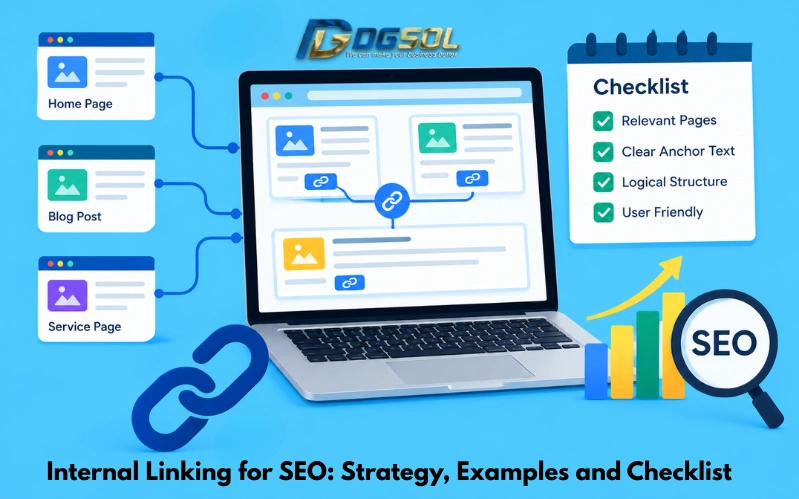
- Internal linking between related pages
- Structured headings (H1, H2, H3)
- Helpful, in-depth content
3. Off-Page SEO (Authority & Trust Building)
Off-page SEO strengthens your website’s reputation across the internet. Google uses these signals to determine how trustworthy your website is compared to competitors. It includes:
- High-quality backlinks from relevant websites
- Digital PR and brand mentions
- Guest posting on authority sites
- Citations and local listings
4. User Experience (UX & Engagement Signals)
User behavior is now a major ranking factor. A well-designed website with strong UX often outperforms competitors with higher content volume. Search engines analyze:
- Time spent on the page
- Bounce rate
- Click-through rate (CTR)
- Mobile usability
- Navigation flow
How AI Has Transformed Search Engine Optimzation Strategy
AI has shifted SEO from keyword-focused writing to intent-driven content ecosystems. It means thin or generic content no longer ranks effectively, even if it is optimized for keywords. Modern search algorithms prioritize:
- Real experience and expertise (E-E-A-T)
- Deep, structured topic coverage
- Original insights and data-backed content
- User satisfaction signals
When SEO is the Best Strategy
It is ideal practice when:
- You want long-term, compounding organic traffic
- You are building brand authority in competitive industries
- You operate in niches like SaaS, healthcare, finance, or B2B services
- You are investing in content marketing and inbound lead generation
- You want to reduce dependency on paid ads over time
For agencies like DGSOL Malaysia, SEO is treated as a long-term business asset that continues generating leads even without ongoing ad spend.
What is Search Engine Marketing?
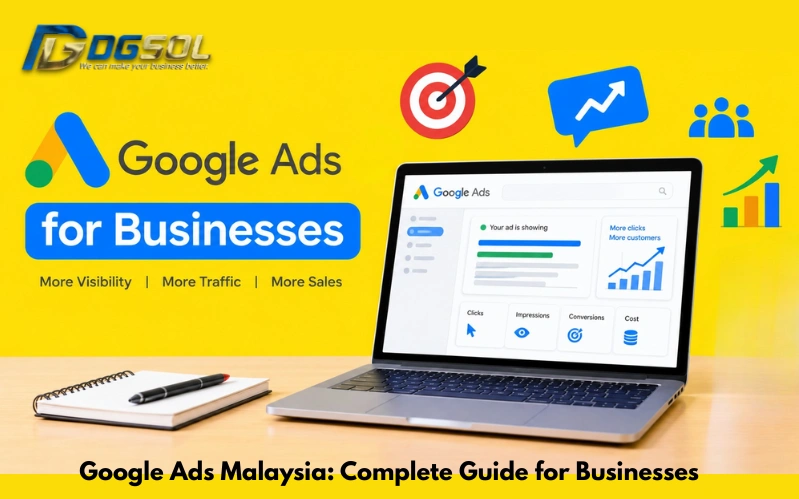
Search Engine Marketing (SEM) refers to paid advertising on search engines such as Google Ads and Microsoft Ads. It is also widely known as Pay-Per-Click (PPC) advertising or paid search marketing. With social media growth strategy for businesses bid on keywords to appear at the top of search results and pay only when users click on ads.
Core Components of Modern SEM (2026 Model)
1. Keyword Targeting & Audience Intelligence
Modern SEM goes beyond keyword matching. It helps advertisers to reach users closer to the buying decision. It includes:
- Intent-based keyword targeting
- Audience segmentation using AI signals
- Behavioral targeting (past searches, interests, demographics)
- Broad match + smart matching strategies
2. AI-Driven Ad Creatives
However, a human strategy is still needed to maintain brand messaging and compliance. Google Ads now uses AI to:
- Generate multiple ad variations
- Test headlines and descriptions automatically
- Optimize ad combinations based on performance
3. Landing Page Optimization (Conversion Focus)
A successful SEM campaign depends heavily on landing page quality. Even the best ads will fail if the landing page is not optimized. Key elements include:
- Fast mobile loading speed
- Clear value proposition
- Strong call-to-action (CTA)
- Message consistency with ads
- Conversion tracking setup
4. Smart Bidding & Automation
AI-powered bidding systems like Google Smart Bidding optimize. These systems continuously adjust bids in real time to maximize ROI.
- Cost-per-click (CPC)
- Cost-per-acquisition (CPA)
- Conversion probability
How AI Has Changed SEM Approach in 2026
AI has automated much of PPC advertising, including bidding, targeting, and optimization. But challenges still remain:
- Rising CPC in competitive industries
- Over-reliance on automation can increase costs
- Lack of strategic control without human oversight
Successful search engine marketing campaigns still require:
- Strategy planning
- Keyword filtering
- Budget optimization
- Conversion tracking analysis
When SEM is the Best Strategy
It is the most effective approach in digital marketing when:
- You need immediate traffic or leads
- You are launching a new product or service
- You want to test market demand quickly
- You operate in highly competitive search markets
- You require predictable lead generation with measurable ROI
For example, agencies like DGSOL Malaysia often use Google Ads to quickly test demand for services like SEO packages, website development, or social media marketing before scaling organically.
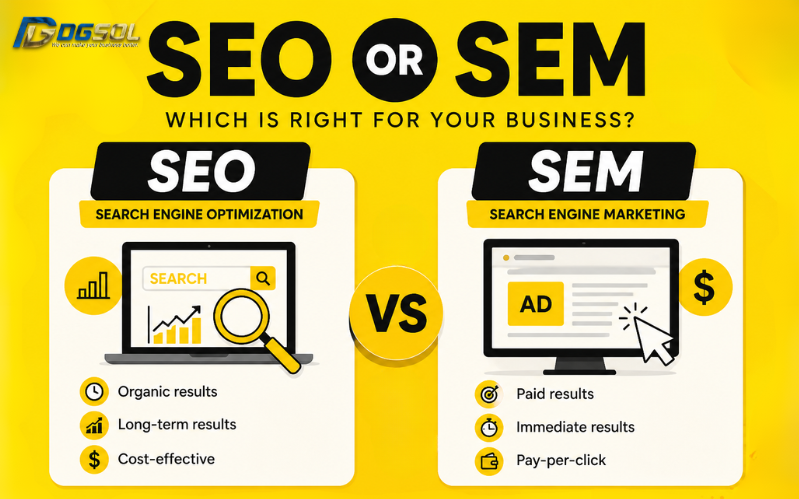
SEO vs SEM: Key Differences in 2026
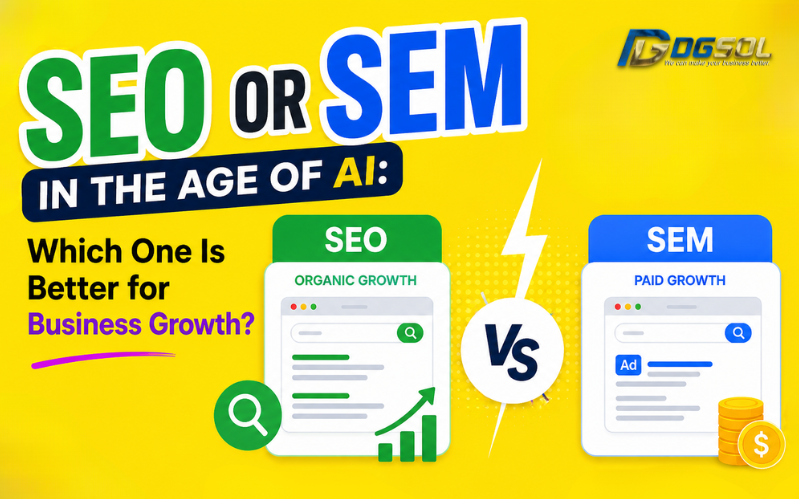
In modern digital marketing, SEO and SEM are no longer separate tactics—they are two parts of a unified search engine growth strategy.
| Factors | SEO (Organic Search Visibility) | SEM (Paid Search / PPC Advertising) |
| Speed | Slow (3–12 months) | Instant visibility |
| Cost | Long-term investment | Pay per click |
| Traffic Type | Organic, sustainable | Paid, immediate |
| Scalability | Content-driven growth | Budget-driven scaling |
| Risk | Algorithm updates | Rising ad costs |
| AI Impact | Rewards expertise & depth | Automates bidding & ads |
SEO or SEM: Which is Better for Business Growth?
The real answer is not one or the other—it is strategic integration.
When SEO Should Be the Priority
Focus on SEO when:
- You are building long-term brand authority
- Your business depends on trust and credibility
- You target high-value industries (finance, SaaS, healthcare)
- You want sustainable inbound traffic
- You are investing in content marketing
When SEM Should Be the Priority
Focus on SEM when:
- You need immediate leads or sales
- You are launching a new offer
- You want to test messaging or pricing
- You are entering a new geographic market
- You need a predictable monthly lead volume
Best Practice: Combined SEO + SEM
The most successful businesses use both channels together, as it creates a full-funnel digital marketing ecosystem.
- SEO builds authority and long-term traffic
- SEM provides fast data and conversions
- AI connects both through analytics and insights
How AI is Reshaping SEO and SEM Strategy
For SEO:
- Focus on topic clusters instead of single keywords
- Build authority-based content (case studies, guides, insights)
- Use structured data for better indexing
For SEM:
- Use AI tools for keyword grouping and analysis
- Optimize ad variations using performance data
- Improve negative keyword filtering
For Both:
- Unified tracking and analytics
- Shared keyword intelligence
- Customer journey mapping
Real-World Use CasesStudies
Scenario 1: Digital Marketing Agency (Malaysia)
A local agency like DGSOL Malaysia can:
- Run Google Ads for “SEO services Malaysia” to generate immediate leads
- Build SEO content around “digital marketing agency Malaysia”
- Create service clusters for SEO, SEM, and web development
Scenario 2: SaaS Business or Online Platform
A SaaS company can:
- Use SEO for educational and informational content
- Use SEM for high-intent keywords like “best CRM software”
- Combine both for full-funnel acquisition
Final Thoughts
The debate of SEO vs SEM in digital marketing is outdated in 2026. Modern growth requires a balanced, AI-enhanced search strategy:
- SEO builds trust, authority, and long-term traffic
- SEM delivers speed, testing, and immediate conversions
- AI improves targeting, optimization, and decision-making
Businesses that combine both consistently outperform competitors relying on only one channel. If you want scalable digital growth, start building a strategy where they work together, not separately.
Contact DGSOL Malaysia for data-driven SEO, SEM, and AI-powered digital marketing solutions tailored for real business growth.
Frequently Asked Questions
What is the difference between SEO and SEM?
Search engine optimization focuses on organic traffic through optimization and content. Search engine marketing uses paid ads like Google Ads to generate immediate traffic.
Is SEO still important in AI search?
Yes. AI search enhances results, but users still rely on organic results for detailed and trustworthy information.
Should small businesses start with SEO or SEM?
Most small businesses benefit from a combination: SEM for quick leads and SEO for long-term growth and development
How does AI impact keyword strategy?
AI shifts the keyword approach from single keywords to topics and intent. Instead of focusing on terms like “SEO Malaysia,” it groups related searches and understands what users actually want. Now uses topic clusters to improve relevance and rankings.
Can AI fully manage SEO and SEM?
AI can automate research and optimization, but it cannot replace a human approach. Humans are still needed for planning, content direction, and decision-making. AI supports SEO and SEM, but humans lead the approach.