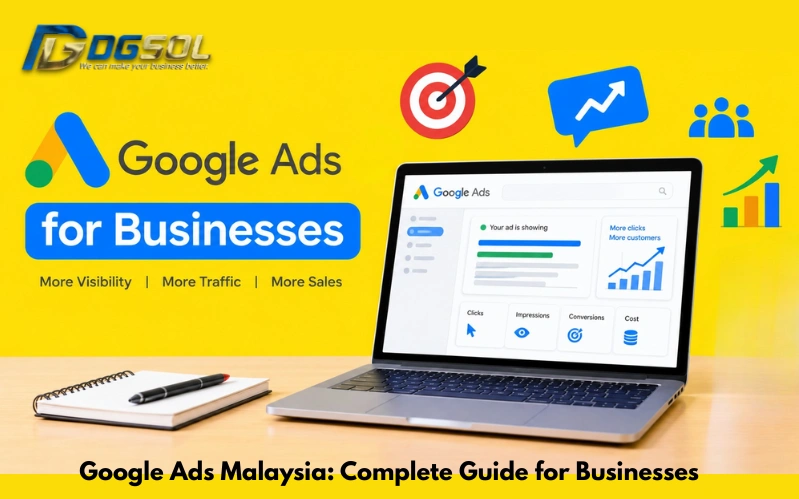
Google Ads is an online advertising platform that helps businesses reach potential customers when they search for products, services, or solutions. For Malaysian businesses, it can support lead generation, online sales, website traffic, and brand awareness when campaigns align with clear business goals.
However, running successful Google Ads campaigns involves more than choosing keywords and setting a daily budget. Businesses need relevant ads, strong landing pages, accurate conversion tracking, and ongoing optimization to know whether their ad spend is delivering real results.
Whether you operate a small business, B2B company, ecommerce store, or local service business, understanding how Google Ads works can help you make better advertising decisions. In this guide, you will learn about Google Ads Malaysia, campaign types, advertising costs, budget planning, keyword research, campaign setup, and conversion tracking in Malaysia.
What Is Google Ads?
Google Ads is Google’s online advertising platform. Businesses can use it to show eligible advertisements across Google’s advertising inventory, depending on the campaign type, targeting, and settings they choose. For example, a Malaysian digital marketing agency could run Search for people who want both paid ads and SEO services for companies in Kuala Lumpur. An online retailer could use product advertising to promote its available products, while a software company could target relevant business searches to generate inquiries.
How Does Google Ads Work?
Google Ads uses an advertising auction to determine which eligible advertisements appear for a particular opportunity. The outcome depends on several factors, including the advertiser’s bid, ad quality, relevance, the expected impact of assets, and the search or placement context. Depending on the campaign and bidding strategy, advertisers may pay for clicks, impressions, or other forms of advertising interaction.
Why Do Businesses Use Google Advertising in Malaysia?
Businesses use Google advertising to reach people already looking for their products or services. Campaign settings allow advertisers to choose relevant locations, languages, audiences, keywords, and business objectives.
For businesses, potential applications include:
- Generating inquiries for professional services.
- Promoting products to online shoppers.
- Reaching customers searching for local services.
- Attracting leads for B2B solutions.
- Increasing app installations or engagement.
- Promoting specific offers, products, or seasonal campaigns.
Campaign performance depends on search demand, competition, targeting, the offer, and the quality of the website experience.
Which Google Ads Campaign Type Is Right for Your Business?
Choosing the right campaign type is an important part of building an effective Google Ads strategy. The best option depends on your business objective, target audience, advertising budget, and available creative assets.
| Campaign type | Suitable use |
| Search | Reaching people searching for relevant products or services |
| Shopping | Promoting ecommerce products with product information |
| Performance Max | Reaching customers across eligible Google advertising channels using a goal-based campaign |
| Display | Building awareness or reaching relevant audiences through visual advertising placements |
| Video | Promoting products or services through video advertising |
| Demand Gen | Reaching and engaging audiences through visual, discovery-oriented advertising |
| App campaigns | Encouraging app installations or selected in-app actions |
Campaign features and availability can vary. Review Google’s official guide to choosing a campaign type before deciding which format best suits your goals.
Google Ads Cost in Malaysia: How Much Should You Budget?
One of the most common questions businesses ask is: how much does Google Ads cost in Malaysia? There is no single price that applies to every business. Your actual advertising costs depend on your industry, keywords, competition, campaign settings, bidding strategy, and the results you want to achieve.
What Determines Google Ads Cost in Malaysia?
There are several factors can influence your campaign costs.
- Keyword competition: Keywords targeted by many competing advertisers may have higher auction costs than less competitive terms.
- Industry: Business services, ecommerce, education, property, and other industries have different demand and competition levels. Actual costs must be researched for the specific campaign.
- Location targeting: Targeting a particular Malaysian city or region can affect which auctions your ads enter, depending on the search demand and competition in that area.
- Ad and landing page relevance: Relevant ads and useful landing pages can improve the advertising experience and affect auction performance.
- Bidding strategy: Different bidding strategies optimize for different outcomes, such as clicks or conversions.
- Conversion value: A campaign targeting high-value contracts may justify a different acquisition cost than a campaign selling low-priced products.
Google Ads Cost Per Click Malaysia
Cost per click, or CPC, is the amount you pay for each click in a cost-per-click advertising setup. For example, if a campaign spends RM600 and receives 200 clicks, its average CPC is:
RM600 ÷ 200 clicks = RM3 per click
This is an illustrative calculation, not an estimate of the average CPC in Malaysia.
Actual CPC can differ from one keyword to another and can change over time. The best way to estimate likely costs is to research relevant keywords, review available bid estimates, and evaluate actual campaign performance.
Google Ads Budget Malaysia: Daily and Monthly Planning
Before launching a campaign, decide how much your business can reasonably spend and what outcomes you need to evaluate. Google Ads allows advertisers to set average daily budgets for many campaigns. For most standard campaigns using average daily budgets, the monthly spending limit is generally calculated using the average daily budget multiplied by 30.4, although billing and budget rules can differ by campaign and setting.
For example:
| Average daily budget | Approximate monthly spending limit |
| RM20 | RM608 |
| RM50 | RM1,520 |
| RM100 | RM3,040 |
| RM150 | RM4,560 |
Google Ads spending can vary from day to day. Review Google’s current campaign budget guidance before setting or changing a budget.
Google Ads Pricing Malaysia: What Costs Should You Include?
When estimating the total cost of Google advertising, consider these separate expenses:
- Advertising spend: The budget allocated to your campaigns and paid to Google.
- Management fees: Charges from an agency, consultant, or freelancer who manages the account.
- Setup fees: One-time charges may apply for account configuration, keyword research, campaign creation, or tracking implementation.
- Additional marketing costs: Landing page development, creative production, analytics implementation, or other supporting work may involve separate charges.
Not every business will incur all these costs. Ask for a clear breakdown before agreeing to an advertising or management package.
Google Ads Keyword Research: How to Find the Right Keywords
Keyword research helps businesses identify searches that are relevant to their products or services. It also helps advertisers avoid spending money on queries that are unlikely to produce valuable results.
Identify Keywords Related to Your Business
Start with the products, services, locations, and customer problems your business can genuinely address.
For example, a digital marketing agency might research:
- Google Ads management
- PPC management services
- Google Ads for small businesses
- Google Ads management fees
Only target terms that match the services you provide and the customers you want to reach.
Use Match Types and Negative Keywords
Match types influence which searches can trigger your ads.
- Broad match can reach searches related to the keyword’s meaning and intent.
- Phrase match can reach searches that include your keyword’s meaning within a relevant phrase.
- Exact match can reach searches with the same meaning or intent as your keyword, even when the wording is not identical.
Negative keywords exclude searches unlikely to be relevant. For example, a company offering paid Google Ads management may exclude certain job-seeking or free-course searches if they don’t fit its audience.
How to Set Up a Google Ads Campaign in Malaysia
A structured setup helps prevent common targeting, tracking, and budget mistakes.
Step 1: Define Your Campaign Goal
Decide what the campaign should achieve. Common objectives include qualified leads, online purchases, phone inquiries, app installations, and other valuable customer actions. Choose a measurable goal rather than relying only on traffic or impressions.
Step 2: Set Location and Language Targeting
Select the areas you can serve, whether that means all of Malaysia, selected states, specific cities, or smaller service areas. Review location targeting options carefully. Depending on the settings, your ads may reach people based on their location or interest in a location, so select the option that best matches your business requirements. Choose suitable language targeting based on your customers and campaign content.
Step 3: Select the Campaign Type
Choose the campaign type that matches your goal, audience, and available assets. For many service businesses targeting people who are actively searching for a solution, Search campaigns may be a useful starting point. Ecommerce retailers may also consider Shopping or Performance Max, depending on their product data, goals, and advertising setup.
Step 4: Organize Keywords and Ad Groups
Build a logical structure around related products, services, or search intent. For example, an agency could separate campaigns or ad groups for Google Ads management, SEO services, and website development when each has a distinct audience and landing page.
Step 5: Write Relevant Ads
Your ads should accurately describe the service or product and explain why a customer should visit the landing page. Use clear headlines, specific benefits, and a relevant call to action. Add eligible assets, such as sitelinks or call information, when they help users choose the next step.
Avoid exaggerated claims, unsupported guarantees, and vague messages that do not tell customers what you offer.
Step 6: Set Your Budget and Bidding Strategy
Choose a budget the business can maintain long enough to evaluate the campaign. Select a bidding strategy based on the campaign goal, conversion data, and level of control required. Do not assume that increasing bids or budgets will automatically make a campaign profitable.
Step 7: Prepare a Relevant Landing Page
The page users reach after clicking an ad should match the advertisement and make the next action clear. For a service campaign, this might include details about the service, benefits, relevant evidence, frequently asked questions, and a clear inquiry form or contact option.
For an ecommerce campaign, product information, pricing, availability, delivery details, and checkout usability are important.
Step 8: Check Everything Before Launch
Before activating the campaign, review:
- Location and language targeting.
- Keyword relevance and negative keywords.
- Ad copy and destination URLs.
- Budget and bidding settings.
- Conversion actions and tracking.
- Landing page functionality on mobile and desktop.
- Billing and account access.
Test important conversion actions so that you can measure outcomes once the campaign begins running.
Google Ads Conversion Tracking: Measure Real Business Results
Conversion tracking helps businesses understand which advertising interactions lead to valuable actions. Without reliable tracking, it is difficult to assess whether a campaign is producing worthwhile results.
How to Set Up Conversion Tracking
For website conversions, the general process involves:
- Define the conversion action in Google Ads.
- Implement the Google tag or an appropriate supported tracking setup.
- Configure the event or action that should count as a conversion.
- Test the setup and check whether events are recorded correctly.
- Review conversion reporting before using the data to optimize campaigns.
Google Tag Manager and linked Google Analytics properties may also be useful, depending on how your website is configured.
Track Forms, Calls, Purchases, and WhatsApp Enquiries
Choose tracking that reflects your business’s actual customer journey. For example, a service company may track successful form submissions and qualified calls. An ecommerce business may track completed purchases and purchase value.
If you use WhatsApp to receive inquiries, distinguish between a click that opens a WhatsApp conversation and an inquiry that becomes a qualified lead. A button click does not, by itself, confirm that a sale occurred.
Use Conversion Data to Improve Campaigns
Review which campaigns, keyword groups, and landing pages generate valuable results. Investigate conversion quality as well as conversion quantity. For example, a campaign with fewer inquiries may be more valuable than one with many inquiries if its leads are more likely to become customers.
How to Optimize Google Ads Campaign Performance
Review Google Ads campaigns regularly. Use the data to identify problems and opportunities rather than making frequent changes without a clear reason.
1. Review Search Terms
Check the searches that trigger your advertisements. Add negative keywords when appropriate and refine targeting to reduce irrelevant traffic.
2. Improve Ad Relevance
Make sure your ads address the intent behind the searches you target. Avoid sending users to a generic page when a more relevant product or service page is available.
3. Improve Landing Page Quality
Review whether the page provides the information promised in the ad and makes the desired action easy. Check load performance, mobile usability, form functionality, and the clarity of the offer.
4. Monitor Key Performance Metrics
Important metrics include:
| Metric | What it measures |
| Impressions | How often ads are shown |
| Clicks | How often users click ads |
| Average CPC | Average cost per click |
| Conversion rate | The share of relevant ad interactions that result in a recorded conversion |
| Cost per lead | Advertising cost divided by recorded leads |
| Cost per acquisition | Advertising cost divided by acquired customers or defined acquisitions |
| ROAS | Tracked revenue attributed to ads divided by advertising spend |
Google Ads Agency: When Should You Hire a Professional?
Managing Google Ads requires keyword research, campaign setup, ad creation, budget management, conversion tracking, analysis, and ongoing optimization.
What Does Google Ads Management Include?
A Google PPC Ads agency or specialist may provide services such as:
- Campaign planning and account audits.
- Keyword research and negative keyword management.
- Campaign and ad group setup.
- Ad copy and advertising asset creation.
- Budget and bidding strategy management.
- Conversion tracking implementation.
- Landing page recommendations.
- Performance monitoring and reporting.
How to Choose a Google Ads Agency in Malaysia
Before hiring a provider, consider these factors.
- Relevant experience: Look for experience with your type of business, target audience, and conversion goals.
- Transparent reporting: The provider should explain how spend, clicks, conversions, and performance will be reported.
- Accurate tracking: Ask how the agency will measure inquiries, purchases, or other meaningful conversions.
- Clear account ownership: Understand who owns the Google Ads account, billing arrangements, and campaign data.
- Defined responsibilities: Confirm who handles landing page changes, creative assets, tracking implementation, and day-to-day communication.
- Realistic expectations: Be cautious of guarantees of specific rankings, leads, or sales without a sound basis.
In-House Management vs Google PPC Management in Malaysia
- Managing campaigns internally provides direct control but requires time, training, and access to suitable expertise.
- Working with an agency can provide specialist support, but it involves a management cost and requires clear communication.
- Choose the option that fits your budget, internal resources, campaign complexity, and business goals.
Common Google Ads Mistakes Businesses Should Avoid
1. Launching Campaigns Without Conversion Tracking
If you only measure clicks, you may not know whether advertising produces qualified inquiries or purchases. Configure and test conversion tracking before relying on campaign performance reports.
2. Targeting Irrelevant Keywords
Keywords that do not match your products or services can attract visitors who are unlikely to become customers. Research search intent, review search terms, and use negative keywords where appropriate.
3. Sending Every Visitor to the Homepage
A landing page should match the product, service, or offer mentioned in the ad. More relevant pages help users find the information they need.
4. Ignoring Lead Quality
A campaign may generate many form submissions without producing valuable business opportunities. Review qualified leads and sales outcomes alongside lead volume.
5. Confusing Ad Spend With Agency Fees
Advertising spend and management charges are different costs. Make sure your budget plan includes both where applicable.
6. Expecting Guaranteed Leads or Sales
Campaign performance depends on demand, competition, targeting, pricing, the offer, the website experience, and the accuracy of conversion data. No responsible provider can guarantee every campaign will produce a fixed result.
Conclusion: Build a Better Google Ads Strategy in Malaysia
Google Ads can help Malaysian businesses reach relevant customers, promote products and services, and generate inquiries when campaigns are planned around clear objectives.
Start by researching relevant keywords, choosing the right campaign type, setting a realistic budget, and creating ads that drive traffic to useful landing pages. Then configure conversion tracking and monitor business outcomes rather than judging performance by clicks alone.
For businesses that need specialist support, a Google Ads agency can help with campaign planning, management, tracking, and reporting. Before hiring a provider, compare the scope of services, management fees, and approach to measuring results.
The goal is not simply to spend more on Google advertising. Use your budget strategically, reach the right audience, and make informed decisions based on measurable business results.
Frequently Asked Questions
What Is a Suitable Google Ads Budget for a Small Business?
There is no universal starting budget. Consider the available funds, expected click costs, value of a qualified lead or sale, and the amount of campaign data needed for evaluation. Start with a sustainable budget and adjust according to results.
How Much Are Google Ads Management Fees in Malaysia?
Management fees vary depending on the provider and scope of work. Request a proposal that clearly separates advertising spend, setup charges, ongoing management, and any additional services.
How Do I Choose a Google Ads Agency in Malaysia?
Review relevant experience, account ownership, tracking implementation, reporting, communication, and the proposed optimization process. Make sure you understand the management fee and services included.
What Is Google Ads Conversion Tracking?
Conversion tracking measures valuable actions associated with advertising, such as purchases, form submissions, qualified calls, or other selected events. It helps businesses assess campaign outcomes beyond clicks.
Is Google Ads Better Than SEO?
Neither is universally better. Google Ads provides paid advertising visibility, while SEO focuses on improving organic search visibility. Businesses can use both channels when they support their goals and budgets.
Can Google Ads Generate Leads Through WhatsApp?
Google Ads can direct users to WhatsApp where the campaign and destination setup support it. However, a click that opens WhatsApp isn’t the same as a qualified inquiry or a completed sale, so measure the customer journey as accurately as possible.