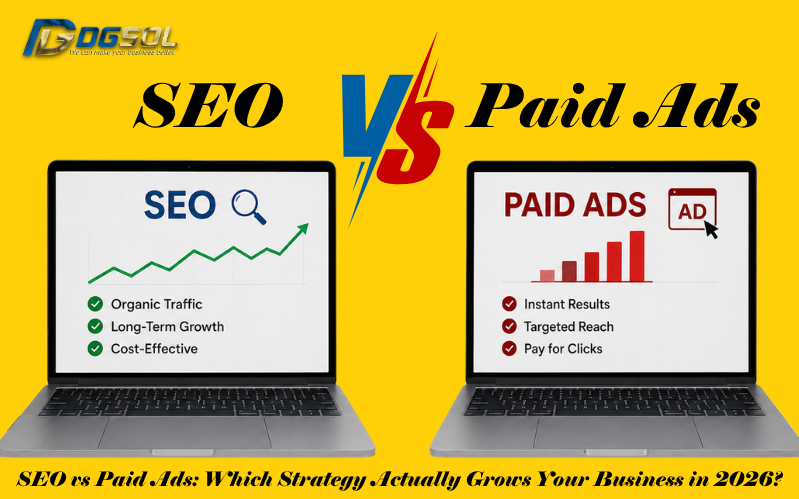
Most businesses don’t fail because they lack traffic—they fail because they choose the wrong way to get it. In 2026, the real debate isn’t whether digital marketing works, but whether you should invest in SEO for long-term growth or paid ads for instant results. One builds lasting visibility that compounds over time, while the other delivers immediate clicks that stop the moment you stop paying. So, which strategy, SEO vs Paid Ads, actually grows your business in today’s competitive digital landscape? At DGSOL Marketing Agency Malaysia, we help businesses navigate this exact decision with data-driven strategies tailored for sustainable growth. So which strategy actually grows your business in today’s competitive digital landscape? Let’s break it down.
Quick Answer:
SEO builds long-term organic authority and sustainable traffic without ongoing ad spend, while paid ads deliver immediate visibility and fast leads. For most Malaysian businesses in 2026, the highest ROI strategy is a smart combination of both starting with paid ads for quick wins and building SEO for compounding growth.
What Is SEO and How Does It Work in Malaysia?
SEO, or Search Engine Optimization, is the process of making your website rank higher in Google’s organic (nonpaid) search results. When someone in KL types “best accounting software Malaysia” or “interior designer Petaling Jaya,” they’re going to see a mix of paid ads and organic results, and SEO is what gets you into that organic section.
It’s not magic. It’s a structured process: you research what your target audience is actually searching for, create content that answers those queries better than your competitors, and build credibility through high-quality backlinks, strong technical site health, and consistent publishing. Over time, Google recognizes your site as a trusted, authoritative source and rewards it with higher rankings.
For Malaysian businesses, effective SEO also means understanding local SEO and search behavior. Queries often include city names like “Shah Alam,” “Subang Jaya,” or “Georgetown.” Language adaptation matters too. English is dominant for professional services, but Bahasa Malaysia keywords carry significant volume in consumer-facing industries like food, retail, and education.
When SEO Delivers Better Returns
- Long-Term Efficiency: For businesses focused on brand building and reducing customer acquisition costs over time, SEO offers a more sustainable and efficient return on investment.
- Cost-Effective Lead Generation: Using a Malaysian B2B software example, SEO can replace high-cost clicks with “zero cost” organic visits through high-quality, authoritative content.
- The Compounding Effect: SEO efforts build momentum; every quality article and technical improvement makes future rankings easier to achieve.
- Widening the Competitive Gap: After a considerable time, the cost difference between SEO and paid ads becomes dramatic, creating a traffic channel that is difficult for competitors to replicate or outbid.
- Proven Resilience: Companies that persist through the slow early stages of SEO eventually secure dominant market positions that provide lasting stability..
DGSOL has seen this play out repeatedly with Malaysian clients in competitive niches: the businesses that stayed committed to SEO through the early months of slow results ended up with traffic channels their competitors couldn’t easily replicate or outbid.
What Are Paid Ads and How Do They Work?
Paid advertising, primarily through Google PPC Ads, because social media increases business growth via Meta Ads, lets you skip the organic queue entirely. You bid on specific keywords or audience segments, your ad appears at the top of the page, and you pay each time someone clicks. The upside is obvious: you can get on page one of Google tomorrow morning if you have the budget. The downside is just as obvious: the moment your budget runs out, your traffic disappears. There’s no residual value, unlike with a well-ranked article or a strong backlink profile.
In Malaysia, the cost per click for competitive industries such as insurance, property, and legal services can range from RM5 to RM30 or more. For niche businesses with tight budgets, this adds up quickly, especially if the landing page or offer isn’t optimized to convert clicks into customers.
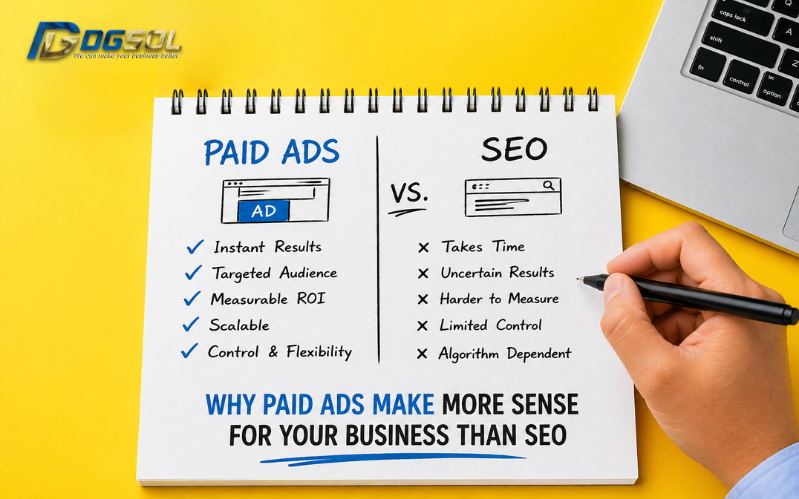
Comparison Table Between Search Engline Optimization Or Paid Ads
| Feature | SEO (Search Engine Optimization) | Paid Ads (PPC/SEM) |
| Time to Results | 3–6 months (Long-term) | Immediate (Short-term) |
| Cost Over Time | Decreases as authority grows | Ongoing spend required to maintain |
| Traffic Sustainability | Continues after you stop publishing | Stops immediately when the budget stops |
| Click-Through Trust | Higher (Organic results are trusted more) | Lower (Users are aware it is an ad) |
| Scalability | Compounds over time | Limited strictly by budget |
| Best For | Long-term brand building and authority | Fast leads, launches, and promotions |
| Local Targeting | Strong with Local SEO strategies | Highly precise and granular |
The Real Costs: SEO vs Paid Ads for Malaysian Businesses
This is where a lot of businesses get confused. People see SEO as “free” and paid ads as expensive, but that framing misses the full picture.
- Investment vs. Expense: SEO requires a monthly commitment (typically RM1,500 to RM8,000) for content and audits, but it creates a permanent traffic asset rather than a temporary spike.
- The “Tap” Effect: Paid ads function like a faucet—the traffic flows only while the money is running—making them ideal for short-term bursts like F&B promos or product launches.
- Long-Term Efficiency: Over a 12 to 24-month horizon, the compounding nature of organic search almost always outperforms the fixed costs of paid campaigns.
- Asset Building: At DGSOL Malaysia, we help businesses from KL to Penang transition from ad dependency to organic dominance by treating search visibility as a high-yield business asset.
When Paid Ads Make More Sense for Your Business
- Immediate Traffic for New Ventures: Paid ads are the smartest move for new businesses lacking domain authority that need instant visibility rather than waiting months for organic growth.
- Time-Sensitive Promotions: They are essential for limited-time offers, such as Raya promotions or product launches, where SEO cannot react quickly enough.
- Hyper-Local and Demographic Targeting: Platforms like Google and Meta allow for precise targeting of Malaysian audiences based on city, age, interests, and specific purchase behaviors.
- Risk Mitigation through Testing: Running small paid campaigns allows businesses to test keyword conversion rates before committing to a full-scale content strategy, removing guesswork from SEO investments.
- The Downside of Exclusive Reliance: Depending solely on paid traffic is a risky long-term strategy, as visibility can vanish instantly due to budget cuts, policy changes, or market shifts.
SEO vs Paid Ads: Which One Suits Your Stage?
Rather than picking one channel for life, think about which one SEO vs Paid Ads fits where your business is right now.
- If you’re a brand new business or a recently launched website with no organic presence, lean on paid ads in the first six months while your SEO foundation is being built. Don’t treat them as competing budgets; treat them as covering different time horizons.
- If you’re an established Malaysian business with decent domain authority but inconsistent organic traffic, doubling down on SEO content and technical optimization will deliver better ROI than increasing ad spend. You’re leaving compounding returns on the table.
- If you’re running a time-sensitive campaign, Hari Raya sales, year-end promotions, or new branch launches, paid ads are the right tool. Speed matters more than efficiency in these windows.
The team at DGSOL understands that every Malaysian business has a different budget ceiling, competitive landscape, and growth timeline. A tailormade digital strategy almost always outperforms a generic “just do SEO” or “just run ads” recommendation.
Expert Insight: What Works in the Malaysian Market
One thing that separates Malaysian digital marketing from global best practices is the local search behavior. Malaysian consumers tend to research heavily before making purchase decisions, especially for higher-ticket services such as renovation, financial planning, insurance, and property. This research phase is where SEO has an outsized impact on blog content, comparison guides, and FAQ pages that answer real questions, building trust long before a purchase decision is made.
Paid ads close deals, but SEO builds the pipeline. In Malaysia’s increasingly online-first economy, businesses that own the informational layer of their industry, the educational content, the how-to guides, and the comparison posts are the ones that competitors find hardest to displace.
Conclusion & Next Steps
SEO vs paid ads isn’t a fight with a clear winner; it’s a timing question. Paid ads give you speed and precision right now. SEO gives you compounding, sustainable traffic over time. The businesses that grow fastest are the ones smart enough to use both in the right proportions at the right stage. Start by auditing where your traffic is coming from today, what your budget can sustain for 12 to 18 months, and what your revenue goals require in the short term. Then build a strategy that uses paid ads for immediate returns while SEO builds a foundation your competitors will struggle to match.
If you’re ready to build a digital marketing strategy that actually fits your Malaysian business, DGSOL is here to help you get it right from day one.
Frequently Asked Questions
Is SEO or paid ads better for small businesses in Malaysia?
For most small businesses with limited budgets, starting with a lean paid ads campaign to generate early revenue while investing in SEO simultaneously gives the best long-term outcome.
How long does SEO take to show results in Malaysia?
On average, expect meaningful organic ranking improvements within 3 to 6 months, with compounding growth through 12 to 18 months of consistent work.
How much should a Malaysian business budget for paid ads?
There’s no one-size-fits-all answer, but a realistic starting budget for Google Ads in a moderately competitive Malaysian market is RM2,000 to RM5,000 per month.
Can I rank on Google without paid ads?
Yes, organic SEO rankings are entirely separate from paid ads. You don’t need to spend on Google Ads to rank organically.
What industries in Malaysia benefit most from SEO?
Industries with high research purchase journeys benefit most: property, finance, education, legal services, healthcare, and B2B software.