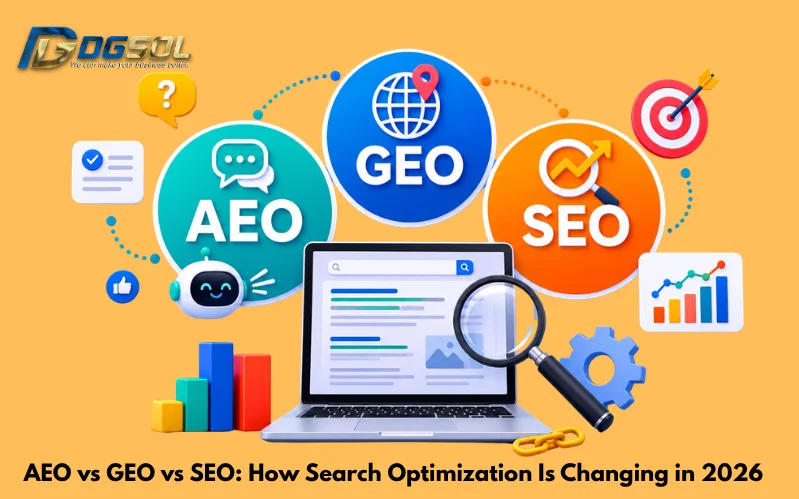
Search is changing rapidly in 2026. People are no longer relying only on traditional Google search results to find information. They are increasingly using AI-powered search experiences, answer engines, chatbots, and generative search platforms to discover information, compare businesses, research products, and make decisions. This shift has introduced new approaches to search optimization, including Answer Engine Optimization (AEO) and Generative Engine Optimization (GEO). While traditional SEO remains essential, businesses now need to understand how SEO, AEO, and GEO work together. Optimizing only for traditional rankings may not be enough to maintain visibility when users increasingly receive direct answers from AI-powered search systems. So, what is the difference between AEO vs GEO vs SEO? Which strategy should businesses use in 2026? And how can companies optimize their content for both traditional search engines and AI-powered search?
What Is SEO?
Search Engine Optimization (SEO) is the process of improving a website and its content so that search engines can understand, index, and rank it for relevant queries. Traditional SEO focuses heavily on improving visibility in search engine results pages (SERPs). An effective SEO strategy for 2026 may include:Keyword researchSearch intent optimization High-quality contentTechnical SEO,On-page SEOInternal linkingBacklink buildingMobile optimizationWebsite speedStructured dataLocal SEOSemantic SEOEntity optimization For example, if someone searches for “digital marketing agency Malaysia,” an SEO strategy aims to help a relevant business page appear prominently in Google’s organic search results.
Why SEO Still Matters in 2026
The growth of AI search does not mean traditional SEO is disappearing.Search engines still need reliable websites, structured information, relevant content, and authoritative sources to understand topics and provide useful results.
SEO remains important for:
- Organic traffic
- Website visibility
- Brand discovery
- Local search
- Product discovery
- Lead generation
- Long-term search visibility
However, the way people interact with search results is changing. This is where AEO and GEO become increasingly important.
What Is AEO?
Answer Engine Optimization (AEO) is the practice of optimizing content so that answer engines can easily understand and provide information from it in response to user questions. Instead of focusing only on ranking a webpage, AEO focuses on making information easy for search systems to extract and present as a direct answer.
AEO content typically provides:
- Direct answers
- Clear definitions
- Concise explanations
- Well-structured headings
- Frequently asked questions
- Step-by-step instructions
- Lists and tables
- Structured information
What Is an AEO Strategy?
An effective AEO strategy focuses on answering the questions your target audience is actually asking. For example, instead of writing a page only around the keyword “SEO services Malaysia,” a business could also answer questions such as:
- What are SEO services?
- How much do SEO services cost?
- How does SEO help Malaysian businesses?
- What does an SEO agency do?
- How long does SEO take?
This gives search engines and answer systems more useful information to understand and potentially surface.
What Is GEO?
Generative Engine Optimization (GEO) is an emerging approach focused on improving a brand’s visibility within AI-generated search responses. Generative search systems can synthesize information from multiple sources and provide a conversational answer rather than simply displaying a list of traditional blue links.
GEO therefore focuses on making content:
- Easy for AI systems to understand
- Factually clear
- Contextually relevant
- Well structured
- Authoritative
- Supported by credible information
- Consistent across the web
The goal is to increase the likelihood that generative search systems recognize, understand, and potentially reference a brand, website, product, service, or piece of information.
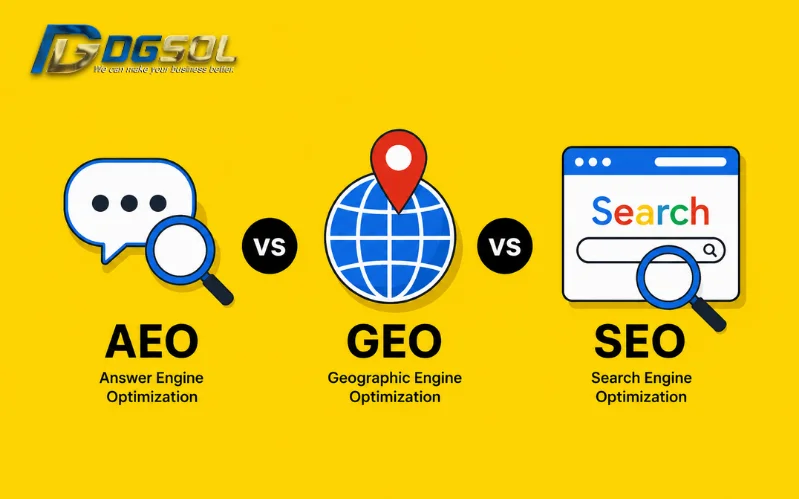
AEO vs GEO vs SEO: What Is the Difference?
The easiest way to understand AEO vs GEO vs SEO is to look at their primary objectives.Although they have different objectives, they overlap significantly.
| Strategy | Main Focus | Primary Goal |
| SEO | Search engine rankings | Increase organic visibility and traffic |
| AEO | Direct answers | Become a useful source for answer-based queries |
| GEO | Generative AI visibility | Improve brand/content visibility in AI-generated responses |
AEO vs SEO: What’s the Difference?
The main difference between AEO vs SEO is the type of visibility each approach targets. SEO traditionally focuses on higher ranking webpages for search queries. AEO focuses more heavily on providing direct answers to questions.
SEO focuses on:
- Rankings
- Organic traffic
- Keywords
- Search intent
- Backlinks
- Technical performance
- Website authority
AEO focuses on:
- Questions
- Direct answers
- Featured-answer opportunities
- Conversational queries
- FAQs
- Structured information
- Clear explanations
AEO vs GEO: What’s the Difference?
The distinction between AEO vs GEO is more subtle because both are connected to AI-driven search. AEO primarily focuses on helping systems answer questions. GEO focuses more broadly on visibility within generative AI experiences.
- AEO
The goal is to provide useful answers to specific questions.
- GEO
The goal is to improve the likelihood of being represented, mentioned, or referenced within AI-generated responses.
For example, a business could optimize an FAQ page for questions such as:
What is local SEO?
That supports AEO.
But a broader GEO strategy might focus on building authoritative content around the company’s expertise, maintaining consistent brand information, publishing original insights, and strengthening the website and brand’s credibility across relevant sources.
GEO vs SEO: What’s the Difference?
GEO vs SEO is another important comparison for businesses adapting to AI search.Traditional SEO focuses primarily on search engine visibility. GEO focuses on visibility within generative search experiences.
SEO often measures:
- Rankings
- Organic traffic
- Impressions
- Clicks
- CTR
- Conversions
GEO may require additional attention to:
- Brand mentions
- AI-generated visibility
- Source references
- Citations
- Entity recognition
- Brand accuracy
- Presence across authoritative sources
How Search Optimization Is Changing in 2026
Search optimization in 2026 is becoming more complex because users have more ways to discover information. Instead of searching only through traditional search engines, users may:
- Ask conversational questions
- Use AI assistants
- Interact with AI-generated search results
- Search using natural language
- Compare several options through AI
- Ask follow-up questions
- Look for summarized information
1. AI Search Is Becoming More Important
AI-powered search is changing how users discover information. Instead of presenting only a list of webpages, modern search experiences can summarize information and help users understand a topic directly. This creates a new challenge for businesses. A company can rank well traditionally but still needs to consider whether its information is understandable and useful to AI-driven search experiences. This is why AI search optimization is becoming an important part of modern digital marketing.
2. Search Is Becoming More Conversational
Users increasingly ask complete questions rather than entering short keyword combinations.
Instead of searching:
SEO Malaysia
A user may ask:
Which SEO strategies work best for small businesses in Malaysia?
Content should therefore address both traditional keywords and natural-language questions.
3. Zero-Click Searches Are Increasingly Important
A zero-click search occurs when a user gets the information they need directly from the search results without visiting a website.
Examples include:
- Definitions
- Weather information
- Business details
- Quick answers
- Calculations
- Featured snippets
- AI-generated summaries
This makes zero-click search optimization increasingly relevant. Businesses should focus not only on getting clicks but also on becoming a recognizable and trusted source of information.
How to Optimize Content for AI Search
Businesses optimizing content for AI search should focus on clarity, authority, relevance, and structure. Here are several practical approaches.
1. Answer Questions Clearly
Start by identifying the questions your audience is asking. Give a direct answer before adding details.
For example:
What Is Technical SEO?
Technical SEO is the process of improving a website’s technical structure so that search engines can crawl, understand, and index its pages more effectively. Then provide supporting information.This structure makes the content easier to understand.
2. Use Clear Content Structure
Clear structure benefits both users and search systems. Use:
- H1 headings
- H2 sections
- H3 subsections
- Short paragraphs
- Bullet points
- Tables
- FAQs
- Step-by-step instructions
3. Demonstrate Expertise
AI search systems need reliable information.Businesses should demonstrate expertise through:
- Original research
- Expert insights
- Case studies
- Data
- Examples
- Author information
- References to credible sources
4. Build Strong Topic Coverage
Instead of creating thin pages targeting individual keywords, build comprehensive topic clusters. For example, a digital marketing website could build a cluster around SEO:
Main topic:
SEO Services Malaysia
Supporting topics:
- Technical SEO
- Local SEO
- SEO audits
- Keyword research
- Link building
- Content SEO
- Mobile SEO
- SEO reporting
This creates stronger topical coverage.
Why Entity SEO Matters for AEO and GEO
Entity SEO focuses on clearly establishing people, organizations, places, products, and other identifiable entities. For example, a business should maintain consistent information about:
- Business name
- Services
- Location
- Industry
- Contact information
- Expertise
- Brand descriptions
Consistency helps search systems understand what the business represents. For companies targeting Malaysia, this can include clear connections between the organization, its services, and locations such as Kuala Lumpur, Selangor, or Penang where relevant.
How to Build an AEO GEO SEO Strategy in 2026
A practical AEO GEO SEO strategy can combine traditional search optimization with AI-focused approaches.
Step 1: Research Search Intent
Identify what users actually want to know. Separate queries into:
- Informational
- Commercial
- Transactional
- Navigational
- Question-based searches
Step 2: Create Comprehensive Content
Develop content that answers the main question and related questions. Avoid creating pages that only repeat keywords.
Step 3: Optimize for Traditional SEO
Focus on:
- Keyword targeting
- Search intent
- Internal linking
- Technical SEO
- Page experience
- Quality backlinks
- Helpful content
Step 4: Add Answer-Focused Sections
This strengthens the AEO side of the strategy. Include:
- FAQs
- Definitions
- Direct answers
- Comparison tables
- Step-by-step guides
- Common questions
Step 5: Strengthen Brand and Entity Signals
Make sure your business information is consistent across:
- Website
- Business profiles
- Social platforms
- Industry directories
- Relevant publications
Step 6: Build Topical Authority
Publish multiple high-quality resources around your core areas of expertise.This creates a stronger knowledge base around your brand.
Step 7: Monitor Search Visibility
Track traditional SEO metrics alongside emerging AI visibility signals where measurable.
Review:
- Organic rankings
- Organic traffic
- Search impressions
- CTR
- Conversions
- Brand mentions
- Referral traffic
- AI-generated visibility
- Citation opportunities
AEO vs GEO vs SEO: Which Strategy Is Best?
There is no single winner in the AEO vs GEO vs SEO comparison. Each strategy serves a different purpose. For most businesses, the best approach is to combine all three.
SEO is best for:
- Organic search rankings
- Website traffic
- Long-term search visibility
- Commercial search
- Local search
AEO is useful for:
- Question-based searches
- Direct answers
- Conversational queries
- FAQs
- Answer engines
GEO is useful for:
- Generative search visibility
- AI-driven discovery
- Brand recognition
- AI-generated responses
- Source and citation visibility
Common Mistakes to Avoid With AEO, GEO and SEO
Here is the common mistakes whcih you need to avoid is given as:
- Focusing Only on Keywords
Keywords remain useful, but content should focus on user intent and meaningful answers rather than keyword repetition.
- Creating Content Only for AI
Don’t sacrifice human readability just to optimize for AI systems.
Content should primarily provide value to real users.
- Ignoring Traditional SEO
AI search does not make technical SEO, content quality, internal linking, and website authority irrelevant.
- Publishing Generic AI Content
Automatically generated content without original value can struggle to establish authority.
Add:
- Experience
- Examples
- Data
- Original insights
- Expert perspectives
- Ignoring Brand Authority
AI search visibility is not only about individual webpages. Strong brand recognition and consistent information can also support broader visibility.
Final Thoughts
The difference between AEO vs GEO vs SEO is mainly about where and how businesses want to achieve visibility. SEO focuses on traditional search visibility and organic rankings. AEO focuses on providing direct answers to user questions, while GEO focuses on improving visibility within generative AI search experiences.
In 2026, businesses do not necessarily need to choose one over another.
The strongest approach is to build a comprehensive AEO, GEO, SEO strategy that combines technical SEO, helpful content, semantic SEO, entity optimization, question-based content, brand authority, and AI search optimization. For businesses, adapting early can create an opportunity to build stronger AI search visibility, improve brand discovery, and remain competitive as search behavior continues to evolve.
Frequently Asked Questions
Is AEO replacing SEO?
No. AEO complements SEO rather than replacing it. Traditional SEO remains important for website discovery, rankings, organic traffic, and technical search visibility.
What is Generative Engine Optimization?
Generative Engine Optimization, or GEO, is an approach focused on improving the visibility and representation of a brand or content within AI-generated search experiences.
How can I optimize content for AI search?
Create clear, accurate, comprehensive, well-structured content that directly answers user questions. Build topical authority, demonstrate expertise, maintain consistent entity information, and support important claims with credible sources where appropriate.
Is SEO still important in 2026?
Yes. SEO remains an important foundation for organic search visibility. Businesses should combine traditional SEO with AEO and GEO approaches as search behavior evolves.
What is zero-click search optimization?
Zero-click search optimization focuses on making information useful and visible directly within search results or answer interfaces, even when users do not click through to a website.
What is AI search optimization?
AI search optimization refers broadly to improving content, website information, and brand signals so that AI-powered search systems can better understand and potentially surface the business or its information.
How can businesses prepare for AI search?
Businesses can combine local SEO with helpful content, AEO, GEO, semantic SEO, entity optimization, strong brand signals, and comprehensive topic coverage relevant to their target Malaysian audiences.