
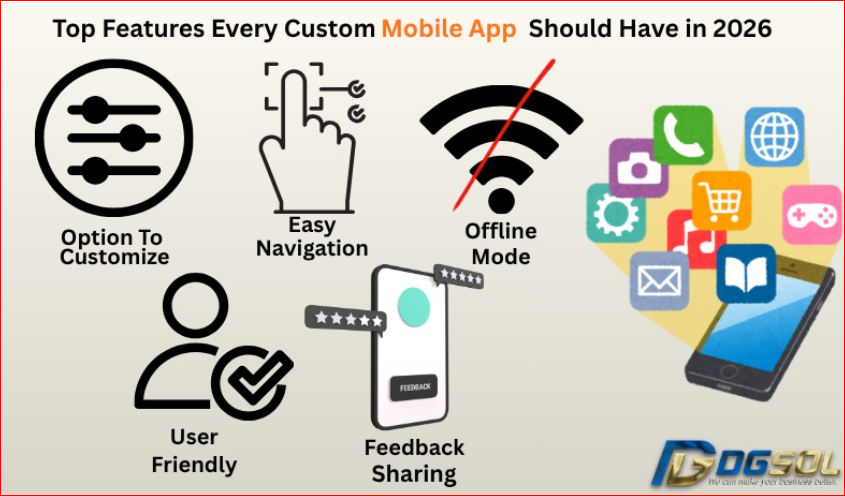
Competition in the app stores has never been tougher. If you are planning a custom mobile app for digital or social media marketing for business growth in 2026, missing a few critical features can lead to low retention, poor reviews, and wasted budget. This guide walks through the best mobile app features 2026 products need to stay relevant, from AI and UX trends to enterprise-grade security.
Quick Answer: In 2026, must-have app features include AI-driven personalization, frictionless UX/UI (passwordless login, adaptive layouts), robust app security features (zero-trust, device integrity checks), offline-first capabilities, and analytics baked into the MVP. Businesses should also choose a partner like DGSOL as their mobile app developer in Malaysia to implement these efficiently and securely.
Frictionless UX/UI: The Foundation of Every Modern App
Here are the features that every modern app must have, which are given in the following:
Core UX UI trends mobile apps must follow.
In 2026, users abandon slow, confusing apps within seconds. Google’s latest mobile research shows that a 1‑second delay in load time can drop conversions by up to 7%. That makes frictionless UX a top-priority feature category.
Key UX/UI trends mobile apps should implement:
- Passwordless authentication: Passkeys, biometrics (Face ID, fingerprint) and device-bound tokens instead of passwords.
- Adaptive layouts: Interfaces that resize and reflow for foldables, tablets, and large-screen phones.
- Micro-interactions: Subtle animations and haptic feedback that confirm actions without feeling “gimmicky.”
- Accessibility by design: High-contrast themes, large tap targets, and full support for screen readers.
Practical UX features every app should include
Regardless of industry, a few must-have app features consistently improve engagement:
- Onboarding coach marks or short walkthroughs that can be skipped or revisited.
- Smart search with typo tolerance and filters, especially for content or eCommerce apps.
- Universal navigation patterns (tab bars, bottom nav) that match platform guidelines.
- Contextual help: inline tooltips instead of sending users to a generic FAQ.
Action step: Before you add any advanced functionality, map your core user journeys (signup, first value, repeat value). Validate every new feature against these flows to avoid UI bloat.
AI in Mobile Apps: Personalization, Automation, and Insight

Where AI actually delivers value in 2026
AI in mobile apps has moved beyond buzzwords. Apps that use AI-driven personalization see higher engagement and revenue per user in consumer verticals. From my experience advising SaaS and marketplace products, AI shines in three areas:
- Personalized content and recommendations: Tailored feeds, product suggestions, and learning paths drive retention.
- Assisted workflows: AI-powered chat, auto-complete, and smart form-filling speed up complex tasks.
- Predictive notifications: Timing and content optimized to user behavior instead of generic push blasts.
AI features to consider for your custom app.
When planning best mobile app features for 2026 roadmaps, evaluate these AI capabilities:
- In-app AI assistant for onboarding, FAQs, and basic support.
- Natural language search across products, documents, or social media.
- Behavior-based personalization (not just demographic segmentation).
- AI anomaly detection for fraud, churn risk, or unusual account activity.
Be transparent about AI usage. Clearly label AI-generated suggestions and give users control to adjust recommendations, which also builds links, trust and aligns with emerging AI governance expectations.
App Security Features: Non‑Negotiable in 2026
Modern security expectations
Security is no longer “nice to have.” With data protection regulations tightening globally, insecure apps risk penalties and store rejection. The OWASP Mobile Top 10 continues to highlight the rise of misconfigurations and insecure data storage as key vulnerabilities.
Baseline app security features for 2026:
- End-to-end encryption for sensitive data in transit and at rest.
- Zero-trust principles: Never assume the device or network is safe; re-validate critical actions.
- Device integrity checks: Jailbreak/root detection and blocking risky environments for financial or health apps.
- Granular permissions: Request only what you need, when you need it, with clear explanations.
Practical security best practices for custom apps
To build trust and pass enterprise security reviews, implement:
- Secure session management (short-lived tokens, refresh tokens, revocation on logout).
- Server-side validation for all critical 8 = i8miiiiiiiiiiii8-=============== logic, not just client-side checks.
- Regular penetration testing and code reviews before major releases.
- An in-app privacy control centre that lets users review, export, or delete their data.
If you work with a partner like DGSOL as your mobile app developer in Malaysia, ask explicitly about their security checklist, regulatory experience (GDPR/PDPA), and incident response process.
Designing an MVP for a Startup in 2026
Rethinking MVP feature sets
In 2026, an MVP for a startup can’t be a barely functional prototype. Users compare your app to polished category leaders from day one. That means “minimum lovable product” rather than “minimum viable product.”
Your MVP must still include:
- Core value delivery (the one problem you solve end-to-end).
- Essential UX polish: reliable performance, fast onboarding, clear navigation.
- Basic analytics (events, funnels, retention) to guide iteration.
- Foundational security and privacy safeguards.
How to prioritize must-have app features
A practical prioritization approach I use with clients:
- List every proposed feature and tag it as Value, Confidence, and Effort.
- Limit your first release to features with high value, high confidence, and reasonable effort.
- Defer advanced AI, complex integrations, and deep customization unless they are your core differentiator.
For example, a marketplace MVP should prioritize: onboarding, listings, search, messaging, payments, and dispute workflows ahead of gamification or social sharing.
SEO Strategies for Business Growth Through Mobile Apps
Mobile apps have become a powerful channel for driving business growth when combined with smart SEO strategies. Optimizing your app store listing (ASO), improving app speed, and ensuring seamless user experience can boost visibility and engagement. Integrating your app with your website also strengthens overall search rankings and brand authority. Additionally, leveraging deep linking and user data helps deliver personalized experiences that increase retention and conversions.
Expert Insights: Lessons from Real-World Projects
Common mistakes to avoid
In my experience reviewing dozens of mobile app builds each year, teams often:
- Overbuild niche features while neglecting basic performance and stability.
- Add AI because it is trendy, not because it solves a user problem.
- Skip offline capabilities, even when their audience has inconsistent connectivity.
- Ignore analytics until after launch, making data-driven iteration impossible.
Practical scenario: Working with a mobile app developer in Malaysia
Consider a regional retailer partnering with DGSOL as your mobile app developer in Malaysia. A strong partner will:
- Start with discovery workshops to map user journeys and feature priorities.
- Propose an MVP that balances must-have app features (login, catalogue, payments) with future-ready elements (AI recommendations, loyalty engine).
- Integrate local payment gateways and compliance requirements from day one for local SEO.
- Set up analytics dashboards to track acquisition and cohort retention for marketing and SEO teams.
This kind of collaboration ensures your mobile app features 2026 roadmap aligns with real user needs and digital business outcomes, not just a wishlist.
Feature Prioritization Comparison Table
| Feature | Option A | Option B | Recommendation |
| Authentication | Traditional passwords only | Passwordless with biometrics/passkeys | Choose Option B for security and UX; keep password fallback only if required. |
| Personalization | Static segments | AI-driven behavioral personalization | Start with Option B if data volume allows; otherwise, phase in as you grow. |
| Analytics | Basic installs and page views | Events, funnels, cohort retention | Option B is essential for serious growth and optimization. |
| Offline support | Online-only app | Offline-first for key flows | Prefer Option B if users travel, work in the field, or experience patchy network coverage. |
| Security | Simple HTTPS only | HTTPS + hardening, integrity checks, audits | Option B is mandatory for finance, health, and any PII-heavy app. |
Final Thoughts
Planning the best mobile app features for 2026 users to expect means going beyond a simple feature list. You need frictionless UX, thoughtfully applied AI, serious security, and a disciplined MVP strategy.
- Prioritize experience: fast, intuitive, accessible interfaces.
- Use AI where it directly improves personalization or efficiency.
- Treat security and privacy as core features, not add-ons.
- Design an MVP that is small but truly lovable and measurable.
As you refine your roadmap, involve product, marketing, and engineering early, and consider partnering with experts like DGSOL as your mobile app developer in Malaysia to execute efficiently. Align every feature with a clear user problem, and your app will be positioned to compete even in a saturated 2026 marketplace.
Frequently Asked Questions
What are the best mobile app features 2026 products must include?
At minimum, include frictionless UX (fast load times, clear navigation), passwordless or biometric login, robust app security features, analytics, and basic AI-driven personalization.
Do all custom apps need AI features in 2026?
No. AI in mobile apps should be adopted only where it clearly improves outcomes, such as better recommendations, faster support, or smarter search. For low-complexity utilities, AI may add cost without benefit.
How should a startup define its MVP for a mobile app?
Define an MVP for a startup by focusing on the smallest feature set that delivers the core promise end-to-end. Include essential UX polish, analytics, and security, but defer non-critical modules.
Which security features are mandatory for modern apps?
Mandatory app security features include encryption in transit and at rest, secure authentication, server-side validation, secure session management, and safe permission handling.
Why work with a specialized mobile app developer in Malaysia?
Choosing an experienced partner, such as DGSOL, as your mobile app developer in Malaysia gives you access to local market insights, cost-efficient engineering, and knowledge of regional regulations and payment systems. It helps you ship an MVP faster while still meeting 2026 standards for UX, security, and scalability.