
In today’s fast-paced digital landscape, businesses must focus on marketing channels that deliver real, measurable results. One of the biggest debates in 2026 is WhatsApp Blasting vs Email Marketing, which channel drives higher ROI, stronger engagement, and sustainable growth? With WhatsApp dominating instant mobile communication and email excelling in automation and lead nurturing, businesses in Malaysia and worldwide face crucial questions: Which channel drives more conversions? Which is more cost-effective? Can one replace the other? This DGSOL marketing guide breaks down everything, including ROI comparisons, cost analysis, automation capabilities, and legal compliance in Malaysia to maximize conversions and long-term growth.
WhatsApp Blasting: How It Works and Why it is important?
WhatsApp blasting is a marketing technique that involves sending bulk promotional or transactional messages to a list of opted-in users. Businesses can leverage multiple tools to execute these campaigns, including the WhatsApp Business App, the WhatsApp Business API, and services offered by official Meta Business Solution Providers. This method is widely used for a variety of purposes such as flash sales, limited-time promotions, appointment reminders, event invitations, product launches, and abandoned cart recovery campaigns. One of the main reasons WhatsApp marketing has gained popularity is its unmatched engagement. Messages are delivered directly to user’s mobile devices and often read within minutes, resulting in significantly higher open rates than traditional email campaigns.
WhatsApp Business App vs WhatsApp Business API
Understanding the difference between the WhatsApp Business App and the WhatsApp Business API is critical for any effective WhatsApp marketing strategy. The WhatsApp Business App is free and suitable for small businesses, offering basic messaging and limited broadcast capabilities. However, it requires manual sending and lacks advanced automation features, making it less ideal for scaling campaigns.
On the other hand, the WhatsApp Business API is a paid solution designed for medium to large businesses that need scalable, automated communication. It allows integration with CRMs, supports chatbots, and enables template-based SMS marketing campaigns that comply with Meta’s policies. Businesses serious about WhatsApp blasting often rely on APIs to streamline workflows, automate responses, and maintain compliance while efficiently reaching large audiences.
What is Email Marketing and Why It Still Works
Email marketing is a digital marketing strategy in which businesses send targeted campaigns to subscribers via platforms such as Mailchimp, ActiveCampaign, HubSpot, or Klaviyo. It remains one of the most profitable marketing channels worldwide due to advanced segmentation, automation, and analytics.
Email marketing is ideal for:
- Nurturing leads and building relationships
- Product education and onboarding
- Newsletter distribution and brand storytelling
- Customer retention campaigns
- Supporting B2B sales cycles
Unlike WhatsApp, email supports long-form content, making it effective for detailed messaging, guiding prospects through the funnel, and building long-term customer loyalty.
ROI Comparison: WhatsApp Blasting vs Email Marketing in 2026
When evaluating WhatsApp Blasting vs Email Marketing, understanding key performance metrics is essential for choosing the right strategy. Below is a detailed description given as:
1. Open Rates
- WhatsApp Blasting: 90–98%
-
- Messages are delivered directly to mobile devices
- High visibility ensures rapid engagement
- Instant notifications increase the likelihood of immediate reads
- Email Marketing: 15–25%
- Often buried in crowded inboxes
- Open rates vary depending on subject lines, timing, and segmentation
- Requires consistent optimization to improve visibility
Insight: WhatsApp dominates in immediate reach and visibility, making it ideal for time-sensitive campaigns.
2. Conversion Rates
- WhatsApp Blasting: 20–35%
-
-
- Particularly effective for flash sales and promotions
- Encourages direct responses due to conversational nature
- Personalised messages improve engagement and purchase likelihood
-
- Email Marketing: 2–8%
-
- Conversion rates vary by industry (B2B often higher than B2C)
- Strong for nurturing leads over a longer period
- Requires well-crafted sequences and follow-ups
Insight: WhatsApp delivers higher short-term conversions, while email excels in long-term lead nurturing.
3. Return on Investment (ROI)
- Email Marketing: $36–$42 return per $1 spent globally
-
-
- High ROI driven by automation, segmentation, and scalable campaigns
- Long-term CLV is maximized through drip campaigns and nurturing workflows
-
- WhatsApp Blasting: ROI varies based on several factors:
-
- Quality of opt-in list: Better-targeted contacts increase ROI
- Message timing: Strategic timing enhances engagement
- Campaign type: Promotions, reminders, and time-sensitive offers perform best
- Automation strategy: Chatbots and API integration streamline communication and reduce cost
Insight: WhatsApp is excellent for short-term revenue spikes, while email marketing generally provides stronger long-term ROI through relationship-building.
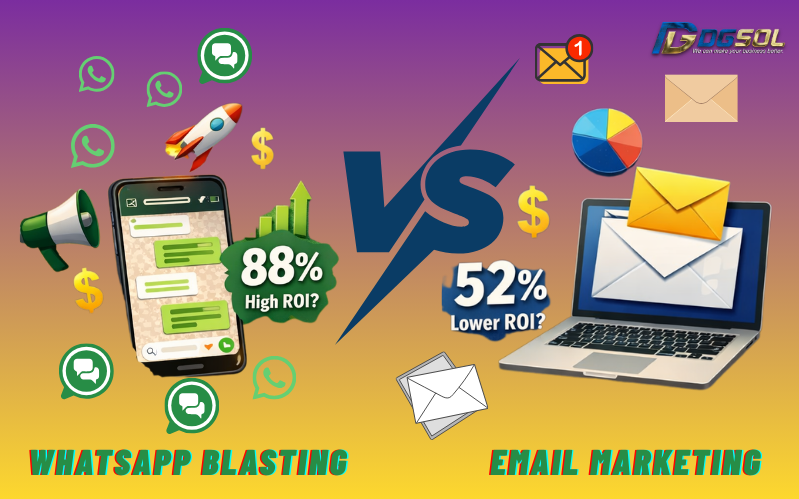
Cost Breakdown in 2026: WhatsApp Blasting vs Email Marketing
Understanding the cost structure is crucial when deciding between WhatsApp Blasting vs Email Marketing. Here is a detailed comparison from DGSOL marketing:
WhatsApp Blasting Costs
- API Setup Fee: One-time fee for connecting your business to the WhatsApp Business API.
- Per Conversation Fee: Charges based on Meta’s pricing model for each conversation sent.
- Business Solution Provider (BSP) Fees: Costs vary depending on your provider and features.
- Chatbot Development (Optional): For automated responses, FAQs, and customer support.
- CRM Integration Cost: Connecting WhatsApp to your CRM system for automated workflows.
WhatsApp pricing is conversation-based, not subscription-based, making it ideal for campaigns focused on direct engagement and short-term conversions.
Email Marketing Costs
- Monthly Subscription Fee: Based on the chosen platform (Mailchimp, HubSpot, ActiveCampaign, etc.).
- Contact List Size Pricing: Larger lists often increase monthly costs.
- Automation Features Cost: Advanced automation, triggers, and workflow setups.
- Design and Copywriting Cost: For professional templates, graphics, and content.
- Deliverability Optimization Tools: Optional services to improve inbox placement and reduce bounce rates.
For larger databases, telegram blasting and email marketing can become more cost-effective over time due to subscription-based pricing and scalable automation.
Automation Capabilities: Enhancing Campaign Efficiency
Automation is a key factor when comparing WhatsApp Blasting vs Email Marketing. It determines how efficiently campaigns run and how much ROI can be achieved.
WhatsApp Automation:
- Automated replies for common queries
- Chatbots for customer support and engagement
- Order confirmations and shipping notifications
- Payment reminders for pending transactions
- Abandoned cart notifications to recover lost sales
Email Automation:
- Welcome sequences for new subscribers
- Drip campaigns to nurture leads over time
- Behaviour-based triggers (e.g., clicks, page visits)
- Lead scoring for prioritizing prospects
- Sales funnel automation for guiding prospects to purchase
- Retargeting flows for abandoned carts and inactive users
Email marketing automation is generally more advanced and flexible than WhatsApp, making it ideal for long-term nurturing and relationship building.
Legal Compliance in Malaysia for WhatsApp and Email Marketing
Both WhatsApp Blasting and Email Marketing require strict adherence to legal regulations to avoid penalties and protect your brand.
WhatsApp Compliance:
- Obtain explicit user opt-in before sending messages
- Use approved message templates for promotions and alerts
- Comply with Meta messaging policies
- Violations may lead to account suspension or banning
Email Compliance:
- Include a visible unsubscribe option in every email
- Comply with Malaysia’s Personal Data Protection Act (PDPA)
- Ensure clear consent from subscribers before sending marketing emails
- Maintain transparent data collection and usage policies
Funnel Strategy: When to Use WhatsApp Blasting vs Email Marketing
To fully leverage WhatsApp Blasting vs Email Marketing, it is essential to align each channel with the customer journey. Here is the DGSOL marketing funnel, with different stages to boost engagement, conversions, and long-term ROI.
1. Awareness Stage
Best Channel: Email Marketing
Why: Email is ideal for delivering educational content, sharing blog posts, and building brand awareness. It enables storytelling and long-form content that introduces your brand to potential customers while nurturing trust over time.
2. Consideration Stage
Best Channel: Email + WhatsApp
Why: During the consideration phase, prospects are evaluating solutions. Email can provide case studies, product comparisons, and detailed guides, while WhatsApp can send quick reminders, answer questions instantly, and reinforce engagement. Combining both channels ensures prospects stay informed and engaged.
3. Conversion Stage
Best Channel: WhatsApp Blasting
Why: WhatsApp excels at driving immediate action. Time-sensitive promotions, flash sales, and abandoned cart reminders sent through WhatsApp generate higher open and response rates, making it the preferred channel for final-stage conversions.
4. Retention Stage
Best Channel: Both Email and WhatsApp
Why: Retaining customers requires continuous engagement. Email can nurture loyalty through newsletters, updates, and reward programs, while WhatsApp provides personalized follow-ups, exclusive offers, and direct communication. Using both channels together strengthens customer relationships and boosts repeat purchases.
Pros and Cons of WhatsApp Blasting and Email Marketing
Understanding the strengths and weaknesses of each channel is crucial for maximizing ROI in 2026.
WhatsApp Marketing Pros
- Extremely High Open Rates: Messages are read within minutes, ensuring immediate visibility.
- Instant Engagement: Direct mobile notifications encourage quick responses and actions.
- Conversational Marketing: Two-way communication enables personalized interactions and real-time support.
- Strong Short-Term Conversions: Ideal for flash sales, promotions, and abandoned cart recovery campaigns.
WhatsApp Marketing Cons
- Strict Messaging Policies: Must comply with Meta rules and approved templates.
- Requires Explicit Opt-In: Only send messages to contacts who have agreed to receive communications.
- Limited Long-Form Content: Not suitable for detailed educational or storytelling content.
- API Setup Complexity: Automation and large-scale campaigns require technical setup and integration.
Email Marketing Pros
- Advanced Automation: Drip campaigns, triggers, and sequences streamline communication over time.
- Deep Segmentation: Send targeted messages based on behaviour, demographics, and interests.
- Detailed Analytics: Track open rates, click-throughs, conversions, and customer engagement.
- Long-Form Content Support: Ideal for newsletters, product education, and B2B communications.
- High Long-Term ROI: Effective for nurturing leads and increasing customer lifetime value.
Email Marketing Cons
- Lower Open Rates: Emails often get buried in crowded inboxes.
- Inbox Competition: Requires strong subject lines and timing to stand out.
- Risk of Spam Filtering: Poor practices can reduce deliverability and campaign effectiveness.
Case Example: Integrated WhatsApp and Email Strategy
A Malaysian online fashion retailer implemented a combined marketing approach:
- Email Sequence: Automated abandoned cart reminders to re-engage customers.
- WhatsApp Follow-Up: Personalized discount messages sent to the same customers.
Results:
- 27% increase in cart recovery compared to previous campaigns.
- 18% higher repeat purchases within three months.
- 35% faster response time from customers receiving WhatsApp notifications.
By using both channels at the right stage of the customer journey, businesses can achieve higher engagement, conversions, and ROI.
Final Thoughts
Both WhatsApp Blasting and Email Marketing offer unique advantages in 2026. WhatsApp excels in speed, engagement, and short-term conversions, while email shines in automation, segmentation, and long-term nurturing. At DGSOL marketing, we recommend integrating both channels strategically to achieve sustainable growth, higher customer retention, and maximum ROI. Start leveraging the strengths of WhatsApp Blasting vs Email Marketing at DGSOL today to create a powerful, multi-channel marketing strategy that delivers real results for your business.
Frequently Asked Questions
Is WhatsApp blasting legal in Malaysia?
Yes, with explicit opt-in consent and compliance with Meta policies and PDPA regulations.
Is email marketing still effective in 2026?
Absolutely. Email continues to provide high ROI and supports long-term customer nurturing.
Which channel is better for small businesses?
WhatsApp for immediate engagement and conversion, while email provides structured, scalable growth.
Can WhatsApp replace email marketing?
No. Both serve different purposes; integrating them delivers the best results.