
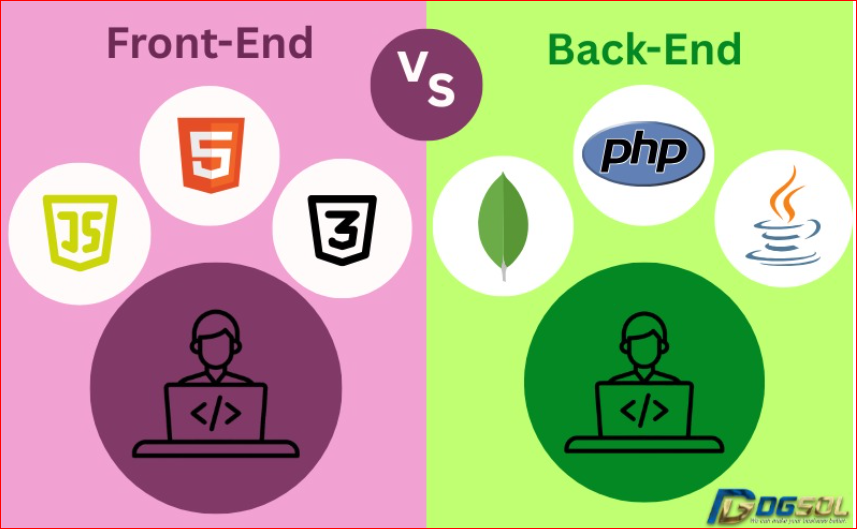
If you still think “frontend = pretty UI” and “backend = databases,” you’re already behind. In 2026, frontend vs backend development is less about aesthetics vs logic and more about who owns user experience, performance, security, and how AI-powered systems behave. This DGSOL article breaks down which frontend developer skills and backend developer skills matter most in 2026, how AI is reshaping both roles, and what it means for hiring, training, and your career roadmap.
In 2026, frontend developers win by mastering modern frameworks, performance, accessibility, and AI-driven UX, while backend developers stand out with strong API design, distributed systems, security, and data/AI integration. Full-stack value now depends on depth in one area plus enough cross-skills to ship end-to-end features.
How frontend vs backend changed by 2026
Since 2023, three shifts have blurred the line between frontend vs backend development:
- AI in web development (2026): LLM-powered features, personalization, and content generation sit across the stack, not just server-side ML.
- Edge and serverless: Logic increasingly runs at the edge (CDN workers, server components), mixing “frontend” and “backend” responsibilities.
- Experience-first product thinking: Businesses care less about which side you code on and more about measurable outcomes (conversion, retention, SEO).
For marketers, bloggers, and product teams, this means role descriptions like “React dev” or “API dev” are less helpful than understanding who can own performance, security, and AI-driven UX.
From my consulting experience with SaaS and media sites, high-performing teams in 2025–2026 share one trait: DGSOL frontend and backend developers both understand user impact and business metrics, not just their part of the codebase.
Core differences: frontend vs backend development
| Aspect | Frontend (2026) | Backend (2026) |
| Main focus | User interface, experience, accessibility | Data, business logic, performance, reliability |
| Primary languages | TypeScript, JavaScript, HTML, CSS | TypeScript/Node.js, Python, Java, Go, C# |
| Key tools | React, Vue, Next.js, design systems | REST/GraphQL APIs, databases, queues, cloud |
| Feedback loop | Immediate, visual, user-facing | Indirect, logs, metrics, SLAs |
| Typical metrics | Core Web Vitals, conversion, usability | Latency, error rates, throughput, cost |
Frontend developer skills that matter most in 2026
Core technical stack: beyond just “knowing React.”
The modern frontend development roadmap in 2026 starts with fundamentals:
- HTML, CSS, JavaScript/TypeScript at an advanced level: semantic HTML, CSS architecture (BEM, utility-first), async patterns, and TypeScript for type safety.
- Component-based frameworks: React, Vue, Svelte, Solid, or Qwik; plus their ecosystem meta-frameworks (Next.js, Nuxt, Remix, SvelteKit).
- Server Components & streaming: frameworks that render partially on the server, then hydrate on the client for speed and SEO.
In practice, teams increasingly prefer developers who understand framework trade-offs over those who blindly apply a single stack.
Performance, Core Web Vitals, and UX quality
Google’s Core Web Vitals updates (2024–2026) have made frontend performance a direct ranking factor and revenue driver. For businesses targeting specific regions, such as those seeking local SEO for the UK, frontend speed is non-negotiable. According to Google’s performance case studies, even small improvements in LCP and INP correlate with conversion lifts.
Critical skills include:
- Measuring and optimizing LCP, CLS, INP with tools like Lighthouse, WebPageTest, and Chrome UX Report.
- Code splitting, lazy loading, and image optimization (modern formats, responsive images, CDNs).
- Understanding server components and edge rendering to reduce JS shipped to the browser.
For content-heavy sites, a strong frontend dev can literally be the difference between page 1 and page 3 rankings.
Accessibility and design systems
Accessibility lawsuits and regulations (like the European Accessibility Act 2025) have turned a11y from “nice-to-have” into a risk-mitigation requirement.
Key skill sets:
- WCAG 2.2+ compliance: proper use of ARIA, keyboard navigation, focus management.
- Building and maintaining design systems (Storybook, Figma integration, tokens, theming).
- Inclusive design patterns (color contrast, motion sensitivity, localization).
In my experience auditing large marketing sites, frontend teams that invest in design systems and accessibility ship faster and spend less time firefighting edge-case bugs.
AI-enhanced frontend: personalization and intelligent UI
AI is no longer just a “backend ML model.” In 2026, frontend devs increasingly handle:
- Integrating LLM APIs directly from the client or via edge functions (e.g., auto-suggestions, on-page assistants).
- Managing AI UX patterns: safe prompt design, user feedback loops, clear AI disclosures.
- Client-side state management for AI-driven experiences (streamed responses, optimistic UI).
Strong frontend developers like DGSOL team understand latency, token usage, and privacy trade-offs when wiring AI into the interface.
Backend developer skills that matter most in 2026
Solid foundation: languages, APIs, and data modeling
While trends change, backend fundamentals remain remarkably stable. However, the modern backend must support various types of seo through structured data delivery and fast server-side execution:
- At least one mature backend language/runtime: Node.js/TypeScript, Python, Go, Java, or .NET.
- API design: REST, GraphQL, and increasingly event-driven APIs (Kafka, NATS).
- Relational and NoSQL data modeling: Postgres, MySQL, plus document or key-value stores.
What changed by 2026 is the expectation of API quality: consistent error handling, versioning, observability, and documentation (OpenAPI, async API specs).
Distributed systems, scalability, and observability
Modern backends live in a world of microservices, serverless functions, and edge runtimes. That has increased demand for:
- Understanding event-driven architectures and message queues.
- Designing for failure: timeouts, retries, circuit breakers, idempotency.
- Observability: logs, traces, metrics using tools like OpenTelemetry.
Industry surveys from 2024–2025 show that downtime and performance issues are now more often caused by integration complexity than raw server limits. Backend developers who can reason about distributed systems are therefore more valuable.
Security, compliance, and privacy
Security has shifted from a specialist-only concern to a core backend competency:
- Authentication and authorization: OAuth2/OIDC, JWT, session management, role-based and attribute-based access control.
- Secure coding: preventing injection, XSS, CSRF, SSRF, and data leaks.
- Compliance awareness: GDPR, CCPA, data residency, logging and retention policies.
When I review job descriptions for enterprise roles in 2026, security is listed explicitly in nearly every backend posting, especially where AI or sensitive data is involved.
AI, data pipelines, and ML integration
Backend developers increasingly orchestrate AI and data workflows:
- Integrating LLMs and vector databases for search, recommendations, and summarization.
- Building data pipelines to collect, store, and transform behavioral data.
- Implementing guardrails: rate limiting, content filters, and audit logs for AI-powered features.
For SEO-heavy businesses, this often powers semantic search, smart internal linking, and content recommendations that improve engagement and revenue.
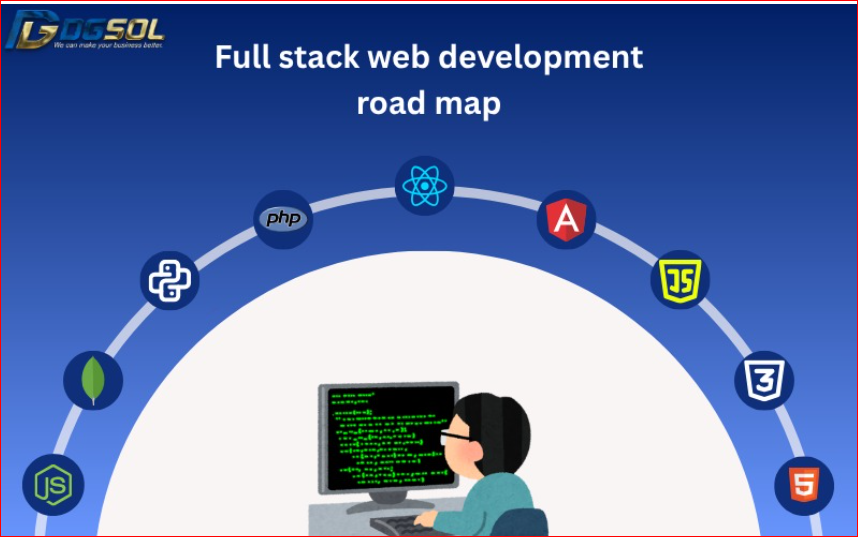
Full stack developer roadmap: where to go deep vs broad
Depth first, then targeted breadth
The full stack developer roadmap in 2026 rewards specialists with strategic breadth. Whether you are focusing on web or mobile app development, a practical path looks like: A practical path looks like:
- Choose a primary depth: frontend experience or backend systems.
- Reach senior-level competency in that area (architecture, mentoring, owning outcomes).
- Add cross-stack skills that let you ship independently: APIs if you’re frontend-first, UI patterns if you’re backend-first.
This aligns with how real teams work: you’re hired for what you’re great at, and trusted more if you can collaborate and fill gaps.
Skill focus by role in 2026
For career and hiring decisions, here’s where to focus:
- If you lean frontend: prioritize performance, accessibility, design systems, and AI-enhanced UX. Get comfortable calling APIs and handling auth flows.
- If you lean backend: focus on distributed systems, security, and data/AI integration. Learn enough frontend to debug UI issues and build simple admin tools.
- If you aim for product ownership: pair technical depth with analytics, experimentation (A/B testing), and basic UX research to inform decisions.
For content-led businesses, a “T-shaped” engineer from DGSOL Malaysia who understands both SEO and engineering can significantly accelerate the implementation of technical SEO, structured data, and performance optimisations.
Conclusion
Frontend vs backend development in 2026 is less about which side you pick and more about how you deliver value across performance, security, and AI-driven experiences.
- Frontend developers win with UX excellence, Core Web Vitals, accessibility, and intelligent interfaces.
- Backend developers stand out with solid APIs, distributed systems, security, and AI/data integration.
- Full stack developers succeed by going deep in one area, then adding targeted breadth.
- Teams perform best when both sides share metrics and responsibilities, especially around AI.
DGSOL Developers are there to help you out in Malaysia.
FAQs
Is frontend or backend development better to learn in 2026?
Neither is better—choose frontend for UX/design, backend for systems/data; both are in high demand.
How has AI changed frontend vs backend roles by 2026?
AI has blurred roles—frontend handles AI-driven UI/UX, backend manages AI logic, data, and security.
What are must-have frontend developer skills in 2026?
JavaScript/TypeScript, modern frameworks, performance optimization, accessibility, and API integration.
What are must-have backend developer skills in 2026?
API design, databases, scalability, security, and AI/service integration.
Does it still make sense to be a full stack developer in 2026?
Yes—focus deeply on one side while staying capable across the stack.